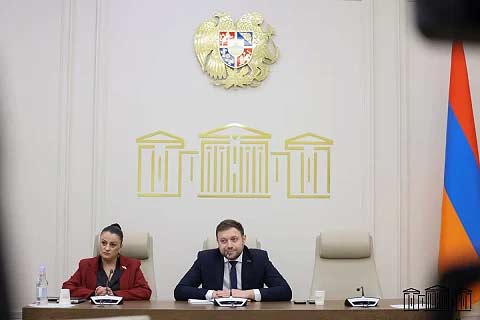



ArmInfo. Today, the Dilijan branch of the Central Bank of Armenia is hosting an international conference with the unusual title "Can Countries Reach an Agreement? Macroeconomic Policy in a Non-Cooperative World." The phrase "non-cooperative world" characterizes a geopolitical landscape where global actors operate in isolation, prioritizing unilateral interests over coordinated international policy.
Global imbalances, energy shocks, tariffs, and so on are all prominent indicators of a "non-cooperative world." The new era of international economic policy, increasingly dominated by tariffs, strategic interventions, and geopolitical considerations, is fundamentally changing global disparities and increasing the risk of economic and geopolitical destabilization. The resurgence of great power politics, multipolarity, and economic fragmentation suggests that global disparities will not merely persist, but transform. This transformation is giving rise to new economic patterns defined by: fragmented trade and capital flows, severely disrupted supply chains, uncoordinated macrofinancial policies and weakened global financial safety nets.
As global value chains are reshaped by the combined pressures of geopolitics, conflict, technological change, and climate policy, the use of tariffs is enabling an asymmetric exercise of economic and political power. At the same time, recent wars and geopolitical tensions have reignited volatility in oil and commodity prices, driving inflation and widening the divergence between energy-importing and energy- exporting nations. In this increasingly fragile and fragmented environment, these overlapping pressures threaten to exacerbate external imbalances and steer the global economy toward a stagflationary trajectory characterized by persistent inflation and decelerating growth.
Today, central banks operate under the dual challenge of anchoring inflation expectations while managing fragile debt dynamics, volatile capital flows, and an uneven economic recovery. At the same time, climate shocks, structural demographic shifts, and geopolitical fragmentation are increasingly testing the limits of traditional monetary systems. The heightened volatility and uncertainty generated by these compounding forces have become defining features of the modern economic landscape.
This shifting paradigm demands more than just routine adjustments to interest rate trajectories; it requires central banks to fundamentally re-evaluate the core frameworks used to formulate and execute monetary policy decisions. Against this backdrop, a critical question emerges: How must monetary policy frameworks evolve to ensure effective decision-making and transparent communication in an era of heightened uncertainty and a highly complex macro-financial environment?
The challenges confronting central banks within an increasingly fragmented international monetary system are acute. As the system undergoes profound structural changes, institutional pressures are intensifying. Specifically, central bank independence is facing renewed scrutiny as expanding fiscal requirements elevate the risk of fiscal dominance. This shift has reignited critical political economy debates regarding the appropriate role, authority, and boundaries of central banks within the modern monetary and financial system.
Inflation dynamics have grown increasingly complex, driven not only by cyclical demand conditions but also by deep-seated supply-side factors. These include persistent supply chain disruptions, energy and commodity price shocks, escalating tariffs, demographic aging, and profound structural transformations. These forces complicate the mandate of central banks, forcing them to balance stubborn inflationary pressures against slowing economic growth and volatile financial markets.
At the same time, financial stability risks are intensifying within a fragmented global environment marked by volatile capital flows, geopolitical uncertainty, and unpredictable shifts in investor sentiment toward emerging markets and traditionally risky asset classes. The rapid proliferation of digital private money and accelerating financial innovation present further challenges. These advancements threaten traditional monetary sovereignty, blur the established boundaries of financial stability, and demand an expansion of existing regulatory and policy frameworks. Will central banks be able to navigate a less integrated and more politicized global landscape while maintaining their institutional reputation, policy effectiveness, and ability to ensure prices and financial stability?
These complex challenges formed the core of the deliberations among conference participants, which included central bank governors, senior monetary officials, representatives from international organizations—such as the International Monetary Fund (IMF), the Bank for International Settlements (BIS), and the World Bank—as well as scholars from leading universities and international experts from prominent research centers and policy think tanks.