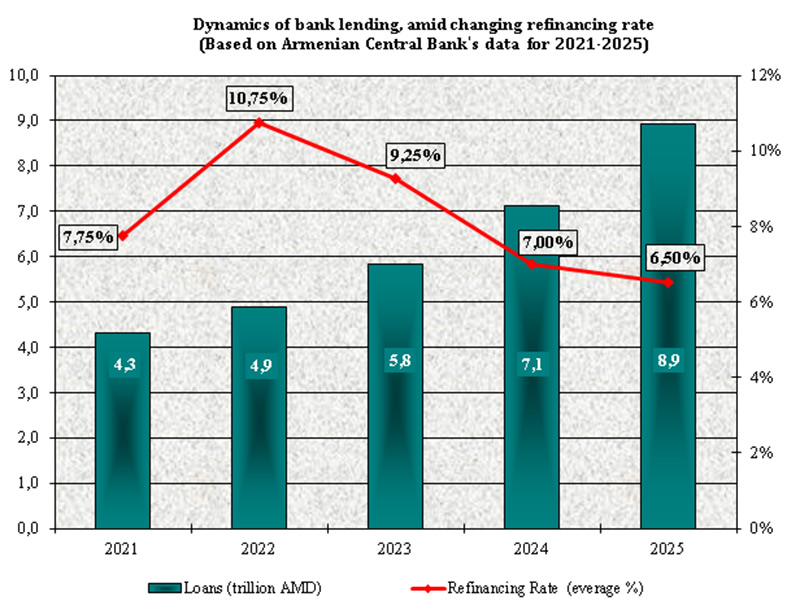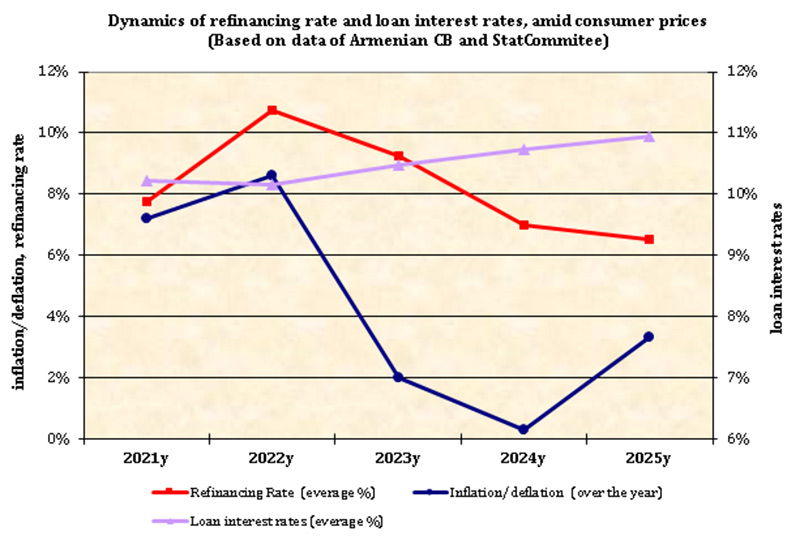


ArmInfo. In the near future, a significant increase in energy prices, as well as disruptions in supply chains and possible changes in trade routes, could contribute to accelerating inflation in the country, as noted in the rationale for the Central Bank of Armenia's decision on May 5 to maintain the refinancing rate at 6.5%.
Furthermore, given the rise in global food prices amid ongoing tensions in the Middle East, the main uncertainties going forward will also relate to their duration and possible impact on Armenia's domestic market. The extent of these factors' impact will depend on the duration and scope of the conflict. On the other hand, growth in service prices and the non-exportable fixed price index (excluding inflation for medical services) continues to trend toward the target level, showing certain acceleration trends. This, combined with the stabilization of wage growth in the private sector in the 5-6% range and the results of direct surveys conducted by the Central Bank, indicates the continued stabilization of inflation expectations near the target level (3%, +/- 1 percentage point).
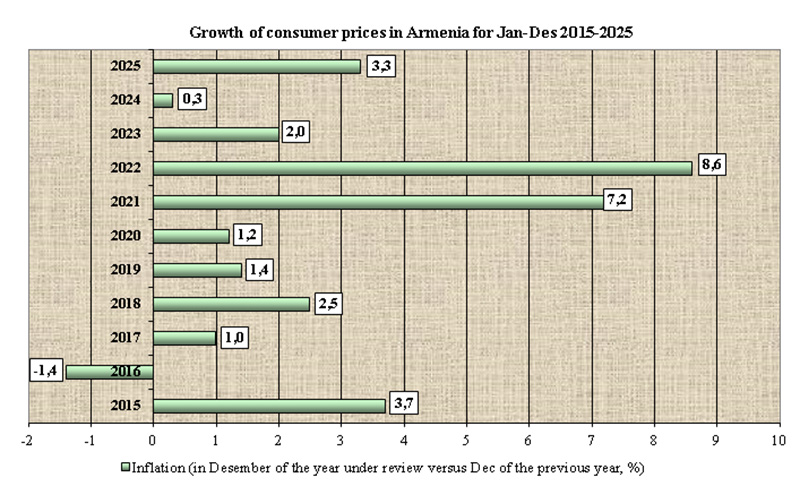
In Q1 2026, annual inflation continued to accelerate, reaching 4.5% in March. This was also reflected in core annual inflation, which stabilized above the target threshold at 4.7% (compared to the target of 3%, +/- 1 percentage point). This, in turn, largely reflects both rising prices for imported goods, particularly food and energy, and the influence of certain supply-side factors in the local economy. At the same time, in recent months, there has been a slight acceleration in inflation for local food products, which, in addition to supply-side factors, may also reflect excess demand in the economy. Moreover, the acceleration in core inflation is more widespread across product groups, which, combined with rising prices for certain non- tradable services, may also indicate this.
In Q1 2026, amid geopolitical uncertainty and significant increases in energy prices and volatility, the risks of weakening demand in the global economy and in Armenia's key partner countries have increased significantly. For example, economic growth in the United States accelerated somewhat in the first quarter, but consumer demand continues to weaken. At the same time, the risks of maintaining high US government debt, and consequently long-term interest rates, have increased due to certain limitations in the ability to collect customs duties, as well as the need for a possible increase in defense spending. In Armenia's other key partner countries, the risks of weakening medium-term growth and demand have become more pronounced. In the Eurozone, economic growth continued to weaken amid persistent structural problems and high vulnerability to energy prices and supplies. Leading indicators of economic activity in Russia indicate an economic slowdown and a significant weakening of domestic demand in the first quarter. Amid ongoing tensions in the Middle East, risks associated with the prospect of rising prices in energy and other commodity markets are intensifying. In this context, given the risks of a weak demand environment and the risks of a significant expansion of inflation, the likelihood of central banks in leading countries maintaining current interest rates for a long time, or raising them in certain cases, is increasing.
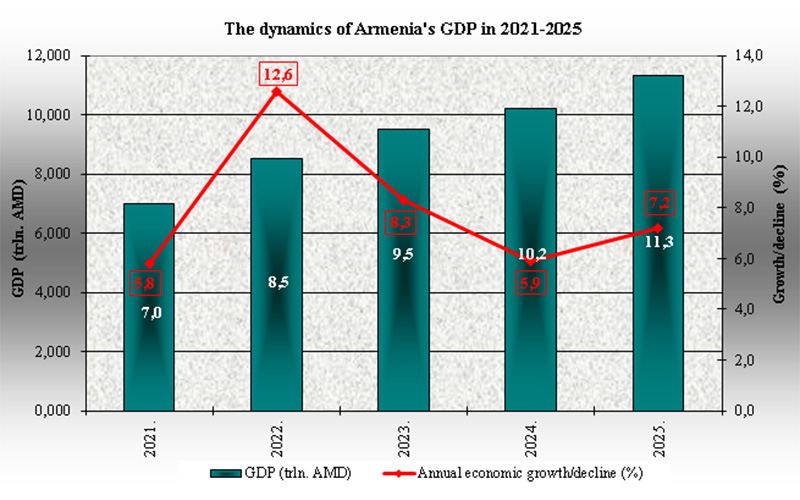
In Q1 2026, Armenia continues to record high economic activity. This is largely due to significant growth in construction and service. It is worth noting that in recent months, high activity in the services sector has been accompanied by a noticeable structural shift toward segments focused primarily on demand expansion, indicating the emergence of conditions of relatively strong domestic demand in the economy. Moreover, there are signs of a certain expansion of external demand, primarily reflected in the growth of tourist flows to Armenia amid ongoing tensions in the Middle East. In this situation, the impact of aggregate demand on inflation is assessed as expansionary, although supply-side risks to inflation dynamics remain significant. It is also noteworthy that the risks of a more accommodative fiscal policy stance have somewhat abated, while wage growth in the private sector and inflation expectations continue to show stabilizing trends. Given the current macroeconomic developments, participants in the Armenian financial market expect the Central Bank to reduce the refinancing rate to 6.25% in the medium term.
Domestic Demand
In Q1 2026, Armenia maintained high economic activity, including due to the influence of certain non- structural and one-off factors, reaching 6.6% in March. Construction and services continued to contribute significantly to economic growth. While services continued to experience high growth rates, their structure has undergone significant changes. Along with weakening growth in the financial sector, particularly in recent months, there has been a significant acceleration in growth in sectors driven primarily by expanding demand, including culture and entertainment, accommodation and catering, professional, scientific, and technical activities, and others. This may indicate an expansion in domestic demand conditions. This is also accompanied by a significant increase in imports and retail trade. On the other hand, the acceleration in growth in manufacturing is primarily due to non-structural factors, and some traditional industries, particularly tobacco production, are already experiencing the negative impact of the conflict in the Middle East, resulting in a reduction in output and exports to countries in the region. Tourist flows to Armenia increased in the first quarter of 2026, reaching a historically high level. Notably, in March 2026, the number of tourists arriving from Iran decreased slightly, while those from Russia increased significantly (by approximately 40% year-on-year), likely reflecting a shift away from the Middle East.
At the same time, strong external demand for local goods, particularly IT and financial services, remains. In the medium term, the external demand forecast will be largely driven by the risks of weakening demand in the global and Russian economies, as well as further geopolitical developments.
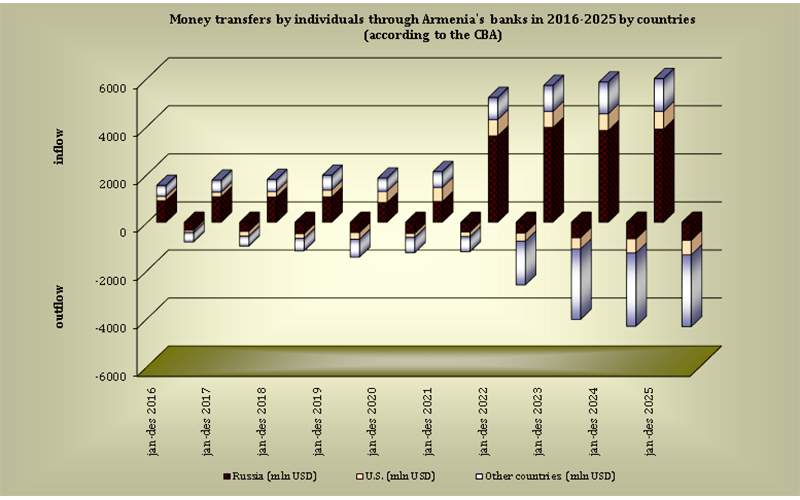
Uncertainty regarding seasonal migration trends to Russia and remittance methods remains. On the one hand, the prolonged retention of the ruble exchange rate at the current level could strengthen incentives for labor migration from Armenia to Russia. On the other hand, a significant weakening of economic growth, high uncertainty regarding the medium-term prospects of the Russian economy, and a tightening of migration policy could, to a certain extent, curb migration flows to Russia, contributing to an increase in labor supply in Armenia and the development of deflationary risks.
In this context, various signals may indicate the formation of a small, near-neutral positive GDP gap in the first quarter of 2026. However, the structural features of economic growth, as well as uneven and mixed changes across various sectors, increase uncertainty regarding the balance of aggregate demand and supply in the economy. On the one hand, high levels of private consumption, accompanied by significant credit growth, as well as robust economic activity in sectors driven primarily by demand expansion amid accelerating inflation, may indicate the presence of excess, strong demand in the economy. On the other hand, the concentration of growth, the stabilization of prices for non-tradable goods (hard prices), and wage growth rates around target or sustainable levels are consistent with the emergence of a more balanced supply and demand situation.
State budget revenues in the first quarter of 2026 were exceeded, which may mitigate the risks of a widening deficit amid rising pensions and social spending. However, the risk of shortfalls in tax revenues remains due to limited scope for further improvements in administration and the possible stabilization of economic growth. Both current and capital expenditures of the state budget, consistent with past trends, were underfulfilled. With the introduction of a universal health insurance system and increases in pensions and benefits, the risks of a more expansionary fiscal policy stance remain, although somewhat mitigated by the current overfulfillment of tax revenues. In the near term, the main uncertainties relate to the potential for further revenue growth and, in particular, the feasibility of capital expenditures in the face of significant structural changes. This, in turn, creates uncertainty both in terms of the impact on demand in the short term and in terms of the expansion of potential growth in the medium term.
Labor Market
The unemployment rate increased slightly in Q4 2025, reaching 13.1%. It is worth noting that, despite recent volatility and the recorded differences between the labor force survey results conducted by the Statistics Committee and the State Revenue Committee, a comparison of several key indicators may indicate a relative equilibrium in the labor market. Specifically, the unemployment rate fluctuates between 12-13%, and the growth of registered jobs and wages, while slowing somewhat, is showing signs of stabilization. However, in recent months, alongside growth in certain service sector segments, wage growth has accelerated. Nominal wage growth in the private sector remained stable at the beginning of 2026, reaching close to 5% year-on-year. On the one hand, the current unemployment rate may partially reflect a certain excess demand that has developed in the labor market especially given that the decline in unemployment in the second half of 2025 may have exceeded the estimated natural rate, and the resulting risks to wages and inflation may still manifest themselves due to wage rigidity. However, it cannot be ruled out that the natural rate of unemployment has gradually declined in recent years, stabilizing in the 11-13% range. This could be facilitated by the expansion of productivity and export opportunities since 2022, the integration and long-term establishment of a highly skilled workforce in the Armenian economy, increased efficiency in matching jobs and labor thanks to the development of various electronic platforms, structural features of economic growth, and other factors. On the other hand, the volume and quantity of non-trade remittances from Russia to Armenia have increased in recent months, which may indicate that the challenges of the ruble's appreciation and the ongoing labor shortage in Russia have outweighed the factors limiting migration flows, stimulating growth in labor flows.
As a result, despite the mixed signals from the labor market, certain developments may indicate a more balanced economic position. In the near future, the main uncertainty relates to the potential for growth in labor supply, particularly if demand conditions expand. At the same time, a possible increase in labor migration flows could lead to a tightening of labor market conditions, creating inflation risks.
Armenia's country risk premium declined to historically low level
Armenia's country risk premium declined to a historically low level in April 2026, amid easing tensions surrounding the Middle East conflict. This may be due to both general trends in emerging markets and factors specific to Armenia, including the continued strengthening of macroeconomic stability, the country's relatively lower vulnerability to energy prices, the presence of relatively stable energy supply sources, and other factors. Global economic growth prospects have worsened Global economic growth prospects have worsened in the first quarter of 2026, driven by ongoing tensions surrounding the conflict in the Middle East, geopolitical uncertainty, and a significant increase in energy prices and volatility. Amid geopolitical events and significant economic policy shifts, US economic growth has exhibited significant volatility in recent quarters, reaching approximately 2% year-on-year in the first quarter of 2026. A significant contribution to the current economic growth rate (around 0.7 percentage points) was made by the recovery in government spending, largely driven by the "restrictions" of US government operations in the previous quarter, while private consumption is gradually slowing. A combination of various labor market indicators also indicates a strengthening of domestic demand. Although asset prices have continued to rise recently, stabilizing at high levels, amid uncertainty about the economic outlook and, particularly, the effective application of AI in other sectors, the risks of a possible price correction remain. At the same time, ongoing geopolitical tensions in the Middle East and restrictions on trade routes pose risks of further deterioration in economic growth prospects and, simultaneously, a significant expansion of the inflationary environment. On the other hand, with the waiver of some customs duties and obligations for accumulated refunds, uncertainty regarding tax revenue collection has increased. Under these circumstances, pursuing a more expansionary fiscal policy, including that driven by the need to increase defense spending, could lead to a significantly higher public debt trajectory in the medium term, creating risks of further increases in long- term real interest rates or their prolonged persistence at elevated levels. Such developments could impact both the US Federal Reserve's monetary policy outlook and the neutral interest rate and capital flows to developing countries.
Inflation accelerated significantly in the first quarter of 2026, reaching 3.3% year-on-year in March. Inflation for fixed prices and services remained relatively stable, remaining well above target. Uncertainty surrounding US foreign and trade policy, rising oil prices, and the resulting additional pressure on other sectors of the economy continue to pose risks of a broader inflationary environment. On the other hand, labor market conditions have been relatively stable in recent quarters, and the sharp rise in energy prices carries the risk of a subsequent undesirable weakening and, simultaneously, a widening inflationary environment. Under these conditions, the US Federal Reserve's mission to ensure price stability and full employment is significantly complicated.
In Q1 2026, Eurozone economic growth continued to weaken, settling at a low 0.1% q/q, reflecting persistent structural problems in industry and the negative impact of the conflict in the Middle East. Due to high vulnerability to energy prices and supplies, inflationary pressures also continue to materialize rapidly: in April 2026, annual inflation amounted to 3% y/y (versus 1.9% in February). At the same time, core inflation indicators are sending mixed signals about demand: core inflation is close to the target level of 2.2% y/y, while service sector inflation remains above the target level of 3% y/y, likely reflecting still-tight labor market conditions. Significant uncertainty remains regarding the current state and growth prospects of the Russian economy. Leading indicators of economic development point to a slight economic contraction in the first quarter of 2026. Although this is largely due to a significant decline in manufacturing output, slowing growth trends are also evident in demand-driven sectors. On the other hand, the contraction in consumer lending and the continued rise in the share of non-performing loans likely indicate weak demand and the accumulation of structural problems in certain sectors of the economy. Labor market conditions remain tight: the unemployment rate remains at a historic low, and real wage growth accelerated significantly at the beginning of the year. Under these conditions, in the first quarter of 2026, despite a slowdown in headline and core inflation, service sector inflation and inflation expectations will remain above target. These developments pose significant challenges for the Central Bank of Russia in terms of effectively managing the inflation-growth dilemma in the short term. In the near term, one of the main sources of uncertainty regarding the Russian economic outlook is the duration of high oil prices from the perspective of demand and, especially, the expansion of budget capacity.
Global oil prices continue to be highly volatile
Global oil prices, amid ongoing tensions surrounding the Middle East conflict, continue to be highly volatile, stabilizing at high levels. In recent weeks, the price has settled in the $100-$120 range, compared to $60-$65 at the beginning of 2026. According to current IEA forecasts, international oil prices in 2026 will be approximately 65% higher than projected before the conflict. However, under various scenarios of protracted conflict and/or damage to energy infrastructure, particularly in countries in the region, the magnitude of oil price increases and the speed of their recovery after the conflict ends could vary significantly. On the other hand, disruptions in the Strait of Hormuz affect not only energy supplies but also commodities essential for agriculture, which also poses risks of rising food prices, which have already partially materialized.