

ArmInfo. Armenia's gross international reserves (GIR) increased by 64% year-on-year, or $2.15 billion, by March 2026, setting a new record of $5.521 billion. In the same period of 2025, they declined by 0.3%, or $9.4 million, to $3.372 billion. In February alone, GIR increased by 6.5% (or $335.2 million), compared to a slight increase of 0.8% (or $27.3 million) a year earlier.
Moreover, monthly growth in GMR began in June 2025, each time reaching a new record high. This continued in 2026, resulting in a 42% increase over this period, or $1.624 billion, according to data from the Central Bank of the Republic of Armenia.
Specifically, the annual growth in GMR in February 2026 was driven by a similar 64% increase in foreign assets in foreign currency to $2.144 billion, with the share of SDRs in the IMF growing by 78% to $4.6 million. This compares to a 0.01% decline in the former and a 61% decline in the latter during the same period in 2025. It's worth recalling that over the past five years, the historical maximum was recorded in 2023. Specifically, in August, both GIR and external assets in foreign currency reached a record high of $4.220 billion and $4.217 billion, respectively. This level was actually surpassed two years later, continuing to grow. The historical maximum of the SDR share in the IMF was recorded in August 2021 at $178.2 million.
In February alone, the growth of GIR resulted from an acceleration in the growth of external assets in foreign currency from 1.6% to 6.6%, while the growth of the SDR share in the IMF slowed sharply, from 13-fold to 1.3%. A year earlier, in February, the former's recovery from a 10.4% decline to 2% growth was accompanied by an acceleration of the latter's meager growth from 0.1% to 0.6%.
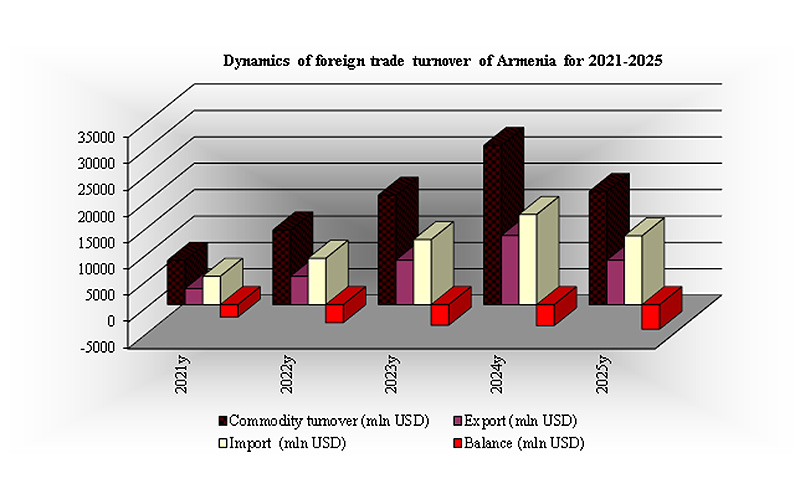
According to the International Monetary Fund (IMF)'s December updated forecast, Armenia's gross international reserves are expected to reach $4.297 billion in 2026, increasing to $4.489 billion in 2027. This will provide 3.4 months of import coverage in 2026, and slightly more coverage in 2027, at 3.5 months. Moreover, the IMF forecasts an improvement in import dynamics in 2026, reaching 2.1% growth (from an actual 23.6% decline in 2025 - Ed.), with a further acceleration in 2027 to 3.7%. The IMF expects the absolute value to increase over these two years from $14.539 billion to $15.074 billion (versus an actual $13.035 billion in 2025 - Ed.).
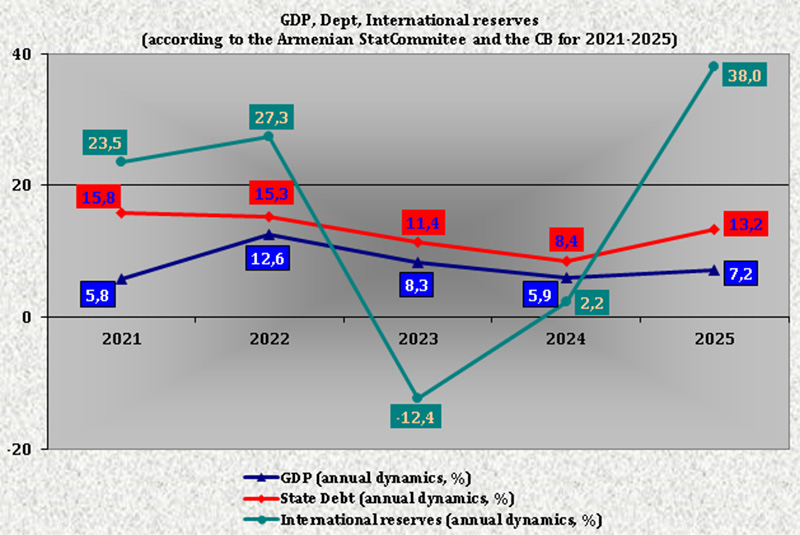
It should be noted that Armenia's gross international reserves (GIR) increased by 38% or $1.4 billion in 2025, reaching $5.086 billion, while in 2024 there was a weak growth of 2.2% or $76.2 million, reaching $3.685 billion. In particular, external assets in foreign currency increased by 38.1% to $5.085 billion, with a decline in the share of SDRs in the IMF by 32.1% to $1.3 million, while in 2024 there was a weak growth of the former by 2.1% and a jump in the latter by 4 times. It's worth noting that in August 2023, both the GMR and external assets in foreign currency reached a record high of $4.220 billion and $4.217 billion, respectively. This level was surpassed two years later, with further monthly record-breaking and a continuation of this trend in 2026. The historical maximum of the SDR share in the IMF was recorded in August 2021 - $178.2 million. The share of bank gold in Armenia's GMR was reset to zero back in December 2003.
As a reminder, in early December 2025, the Executive Board of the International Monetary Fund (IMF) approved a new three-year Stand-By Arrangement (SBA) with Armenia for a total of SDR 128.8 million, or approximately $175 million (100% of Armenia's IMF quota). Concurrently, the IMF completed the previous, sixth review under the SBA, which was set to expire on December 11, 2025. With the IMF Board's approval of the new SBA, an amount equivalent to SDR 18.4 million (approximately $25 million) becomes immediately available to Armenia. The remaining amount will be disbursed in equal tranches, subject to six semi-annual reviews. The new SBA, viewed by the Armenian authorities as precautionary, is aimed at ensuring the continuity of government policies and the structural reform program to maintain macroeconomic stability, promote sustainable and inclusive growth, and provide protection against downside risks in an uncertain environment.