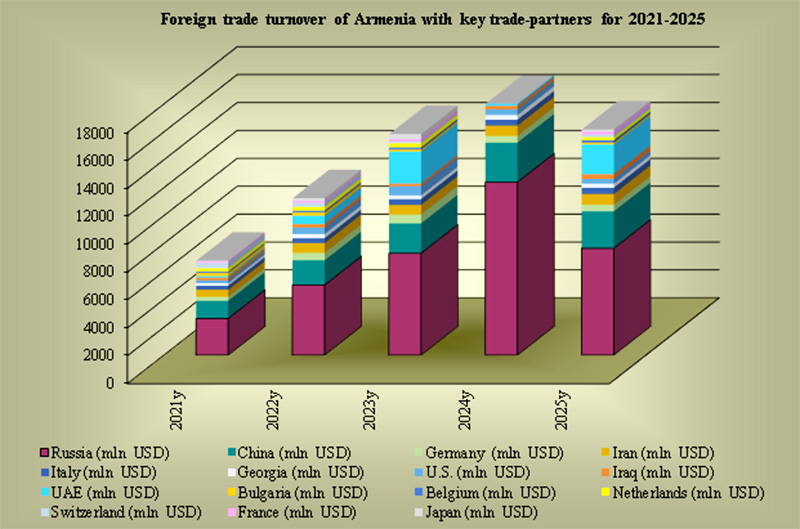


ArmInfo.The share of Armenia's top 5 trading partners-Russia, China, the UAE, Iran, and Germany-decreased by 2025 to a combined 64% of total turnover, amounting to $13.7 billion in absolute terms (compared to $21.8 billion, or 72%, in 2024). Four of them reduced their volumes year-on-year: Russia by 38.3%, China by 6.5%, the UAE by 60%, and Germany by 2.5%. A year ago, Russia, the UAE, and China demonstrated significant growth, while Germany experienced a more pronounced decline.
Iran, meanwhile, managed to maintain growth, with a slight slowdown in annual rates from 6.5% to 4.2%. According to data from the RA Statistics Committee, the significant decline in foreign trade between Russia and the UAE with Armenia is due to the elimination of the re-export and re-import of diamonds and gold.
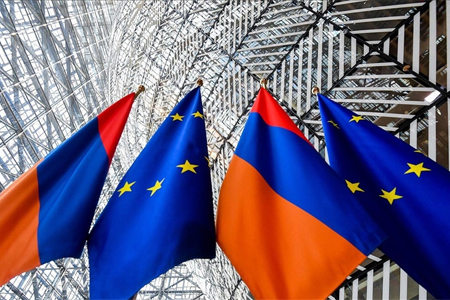
Overall, Armenia's foreign trade with the EAEU fell by 36.9% in 2025 (versus a 54% increase in 2024) to $8 billion, while with the EU, it grew by 7.2% (versus an 11.7% decline in 2024) to $2.5 billion. Among the EAEU countries, Russia recorded a significant decline, while most EU countries, including the Netherlands, France, Romania, Austria, Belgium, Spain, Slovakia, Finland, Italy, Greece, Poland, Hungary, Sweden, and Cyprus, chose to increase their trade. This change in annual dynamics reduced the share of the EAEU in the structure of Armenia's foreign trade from 42.3% to 37.5% (due to the Russian Federation - from 41.1% to 35.8%), while the share of the EU, on the contrary, increased from 7.7% to 11.7%.
Armenia's top five trading partners-Russia, China, the UAE, Iran, and Germany-will account for $7.7 billion, $2.6 billion, $2.1 billion, $768.1 million, and $474.2 million in foreign trade in 2025, respectively. In particular, import dynamics in the direction of Russia worsened from a significant increase to a significant 49.2% decline (to $4.7 billion), while exports remained in decline, slowing from 10.7% to 6.9% (to $2.96 billion). In the direction of China, the deterioration of the export dynamics from a several-fold growth to a 30.4% decline was accompanied by an acceleration of import growth from 3% to 8.8%, the values of which amounted to $763.6 million and $1.9 billion, respectively. In the direction of the UAE, the deterioration of the export dynamics from a several-fold growth to a 60.9% decline was accompanied by a deterioration of the import dynamics from 12% growth to 4.1% decline, the values of which amounted to $2.05 billion and $79 million, respectively. In the direction of Iran, in parallel with the acceleration of import growth from 5.2% to 8.1%, there was a deterioration in the export trend from 14.5% growth to 18.3% decline, the values of which amounted to $679.9 million and $88.2 million, respectively. In the direction of Germany, the exit of exports from a moderate double-digit 27.3% decline to a significant 76.7% growth was accompanied by a slowdown Imports declined from 23.2% to 14.4%, reaching $112.4 million and $361.7 million, respectively.
The top five exporters are Russia, the UAE, China, Iraq ($331.6 million, up 34.7%), and Switzerland ($156.8 million, up 40.1%). The top five importers are Russia, China, Iran, Italy ($386.4 million, up 9.1%), and Germany.
It's worth noting that, of these destinations, Russia and the UAE were the ones that generated significant volumes of exports and imports through Armenia in the previous two years, via transit operations involving gold and diamonds. According to customs data for 2024, the lion's share of diamond and gold imports came from Russia-73% and 99.4%, respectively-while the dominant export of these precious metals and stones came from the UAE (74.8% diamonds and 70.2% gold). A nearly identical picture emerged for 2023, but then Russia accounted for 46.7% of diamonds and 99.2% of gold, which were also primarily exported to the UAE (84.6% diamonds and 71.4% gold). However, the current sectoral breakdown of Armenia's foreign trade (statistics for 2025) already indicates a significant decline in the share of precious metals and stones to 20% of imports and 34% of exports (from 43% and 61%, respectively, in 2024). This is because, starting in 2025, conducting such transactions at the previous volume became impossible due to the settlement of customs duties on jewelry within the Eurasian Economic Union (EAEU), and Russia's zeroing of duties on jewelry imports from the UAE. However, customs data for the first half of 2025 still demonstrate the dominant share of these two directions in the trade of precious metals and stones: diamonds have now begun to be imported from the UAE (52.1%), subsequently exported there (59.4%) and slightly less to Russia (36.4%), while gold continued to be imported from Russia (91.6%) and exported to the UAE (91.3%).
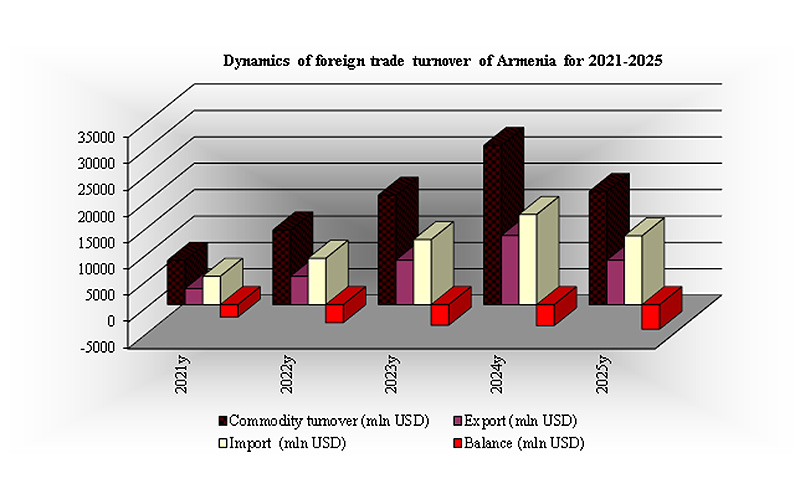
In total, Armenia's foreign trade turnover for 2025 amounted to $21.4 billion, a 29% year-on-year decline (versus 41.5% growth in 2024). In particular, a deterioration in dynamics was noted for both exports and imports, with a 36.1-23.6% decline (from 53.1- 33.8% growth in 2024), the volumes of which fell to $8.4 billion and $13 billion, respectively. Armenia's negative foreign trade balance for 2025 increased by 18% annually, to $4.6 billion, of which the negative $1.6 billion and $1.2 billion are the balances with the EAEU and EU countries, with a significant decline in the former and an insignificant increase in the latter. A significant negative balance is also being recorded in foreign trade with China this time - $1.1 billion (a twofold increase year-on-year). Moreover, among the EAEU countries, Russia has a significant negative balance - $1.7 billion (a nearly fourfold decrease year-on-year). The positive trade balance with the UAE has also declined almost threefold, to $1.98 billion.
The Central Bank of Armenia, in its updated December forecast, predicted that, after nearly equal growth in exports and imports in 2023 of 30.7-30.2% and a decline of 11- 3.2% in 2024, the deficit would deepen in 2025 to 37.3-36.1% (for exports) and 32.7- 32.5% (for imports). However, as early as 2026, the Central Bank expects both export growth to improve by 4.5-3.4%, and import growth to improve by 3.1%, with this trend continuing in 2027 to 3.9-4.1% (for exports) and 4.2-3.8% (for imports). In its December 2025 forecast, the IMF predicted a 31.1% decline in exports and a 28.1% decline in imports for Armenia, with growth returning to nearly identical 2.2-2.1% growth in 2026 and further accelerating to 3.4-3.7% in 2027.