

ArmInfo. The Central Bank of Armenia has decided to further increase the regulatory capital buffer (CCB) to 2.25%, effective May 2027. Prior to this, the CCB will be raised from the current 1.75% to 2% starting in February 2027 (according to the Central Bank's decision of July 28, 2026). As noted in the Central Bank's announcement published yesterday, the Central Bank's Board made the decision to increase the CCB to 2.25% on October 20 of this year, based on a comprehensive analysis of macro-financial and credit market developments.
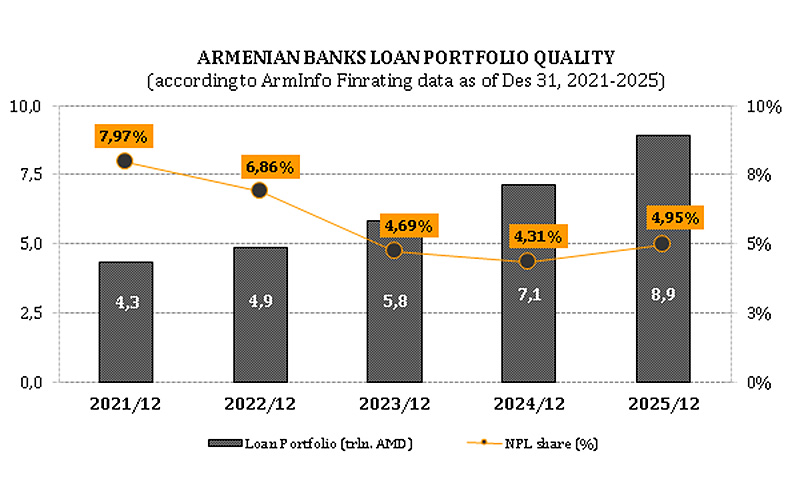
The analysis substantiating the Central Bank's current decision regarding the CCB showed: First, the estimated loan-to-GDP ratio continued to grow, reaching 1.75% in the second quarter of this year. 87% (versus 84% in the previous quarter). Accordingly, the loan-to-GDP gap widened by almost 6.6 percentage points. The financial cycle index also increased during this period, primarily due to the growth in real estate market activity that has been evident since the beginning of the year and the continued high growth rate of lending.
Secondly, the overall high activity in the lending market during the reporting quarter was almost maintained, as evidenced by the growth rates of both the total loan portfolio and lending by industry. In particular, the high annual growth rate of the loan portfolio remained. Consumer loans also continued to grow strongly, despite a slight slowdown since the beginning of the year. At the same time, mortgage lending, after steady downward trends noted last year, has accelerated since the beginning of this year.
Thirdly, the real estate market has seen upward trends. In particular, the average real estate price has increased significantly compared to the beginning of the year, which may be due to increased external demand and the increased interest in real estate as an investment asset recorded in the domestic market. Considering the intensification of mortgage lending and the continued high pace of lending to the construction sector, this may signal a new stage of acceleration with an accompanying possible accumulation of risks.
Fourth, the Central Bank of Armenia is constantly monitoring developments in the real estate market (including mortgages and lending to the construction sector) to assess the feasibility of revising relevant actions/instruments aimed at minimizing/eliminating the potential accumulation of risks in this area.
It should be noted that the Central Bank initially decided to introduce a supplement to the capital ratio for banks – the countercyclical capital buffer (CCB) – on July 31, 2020, setting it at 0% of risk-weighted assets, with effect from August of that year. Since then, the budget classification code (BCC) bar has been kept at zero for more than 2 years. Then, on October 24, 2022, the Central Bank Council decided to increase the BCC from zero to 1%, with this norm coming into force in May 2023. Then, in May 2023, a decision was made to increase the BCC from August of the same year to 1.5% and maintain this level until May 2025, after which a further increase followed to 1.75% and this bar, according to the decision of the Central Bank dated July 28, 2026, will be increased from February 2027 to 2%, and then from May 2027 there will be another increase to 2.25% (this decision was made by the Central Bank on October 20, 2026). Incidentally, with the publication of the July decision to increase the CCB to 2%, the Central Bank cited estimates from macro-stress testing, according to which the amount of additional capital required to absorb unexpected losses resulting from a projected shock at the current stage of the financial cycle is estimated at almost 211 billion drams, or 2.04% of risk-weighted assets.
The countercyclical buffer is necessary to cover bank losses in the event of systemic risk reaching extreme levels in the banking sector. According to the Procedure for "Calculating and Establishing Thresholds for Capital Adequacy Buffering in Banks," the regulator reviews the CCB threshold quarterly. This buffer is intended to support the stability of the banking sector. Changes in the CCB (upward or downward) depend on macro-financial conditions, the degree of uncertainty, and the systemic risk scenario.