


ArmInfo. The credit gap (GAP) for the second half of the year will be 4.3%, indicating that the debt burden is growing somewhat faster than revenue growth. Deputy Economy Minister Sevak Mikaelyan announced this on October 20 during a meeting of the Parliamentary Standing Committee on Financial, Credit, and Budgetary Affairs. He noted that in recent years, the consumer loan portfolio has grown by an average of 30% annually.
The Deputy Minister noted that, in this regard, the Central Bank has decided to increase the countercyclical capital buffer from the current 1.75% to 2% (effective February 1, 2027 - Ed.). "Other instruments were also used, but a step has already been taken to exert a restraining effect on this indicator," Mikaelyan noted.
Overall, he did not disagree that the majority of the Armenian banking system's loan portfolio is represented by consumer and mortgage loans. "However, according to the latest published data, business loans have already exceeded half of the volume, amounting to 54%, while at the end of the first and second quarters they accounted for 46%," Mikaelyan added.
As a reminder, the Central Bank justified its decision (made in July 2026) to increase the countercyclical capital buffer from 1.75% to 2% of risk-weighted assets as follows: the loan portfolio continued to grow at a high annual rate, and high activity was recorded in almost all areas of lending. In particular, the trend of accelerated growth in consumer loans continued, reflected in high annual growth in both reserves and the volume of loans issued in the first half of 2026. Mortgage loan growth stabilized at a level lower than in previous years. However, the volume of mortgage loans issued in the first half of 2026 significantly exceeded the same period last year. As a result, household debt burdens and debt servicing continued to grow, reaching levels that matched or exceeded historical highs. Furthermore, the real estate market has seen accelerating annual price growth. Given the large volumes of mortgage loans and construction lending issued in previous years, the Central Bank continues to focus on ongoing monitoring of potential credit risk accumulation on bank balance sheets and timely responses to these risks. According to macro-stress testing estimates, the amount of additional capital required to absorb unexpected losses from a projected shock at the current stage of the financial cycle is estimated at nearly 211 billion drams, or 2.04% of risk-weighted assets. Risks emanating from regional economic, trade, and political uncertainty continue to dominate the list of financial stability risks. In particular, given the current conflicts, there is a high probability of sharp, frequently occurring, and simultaneous shocks affecting the macroenvironment.
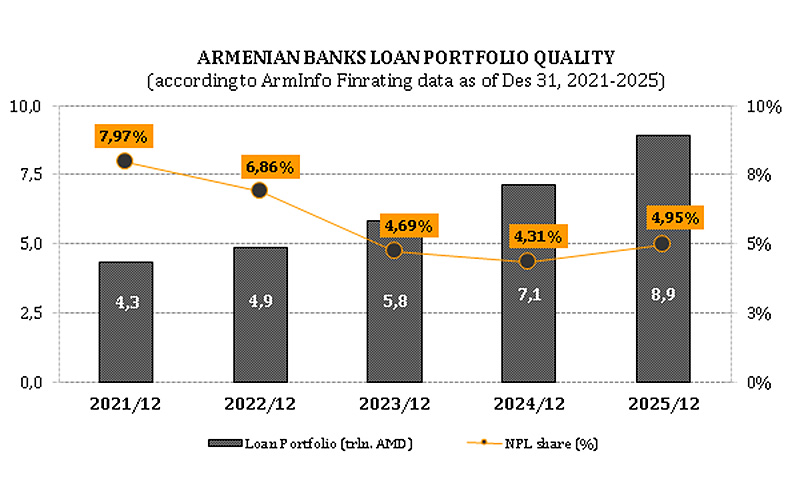
It should be noted that this regulatory supplement—the countercyclical capital buffer—is necessary to cover bank losses in the event of extreme systemic risk in the banking sector. This 1% surcharge was introduced in May 2023, then increased to 1.5% in August of that year, and almost two years later, in May 2025, to 1.75%, which will be in effect until February 2027. According to the Financial Rating of Armenian Banks as of June 30, 2026, prepared by ArmInfo Investment Company, consumer loans account for 40% of the total loan portfolio, while mortgage loans account for almost 19%. The annual growth rate of consumer loans slowed less significantly, from 27% to 23%, than that of mortgage loans, from 33% to 16%. It's worth noting, however, that consumer loans lead not only in terms of loan portfolio size but also in terms of the share of overdue loans, which rose from 38% to 42% of the total NPL volume over the year. Moreover, the riskiest groups (dubious and bad loans) dominate overdue consumer loans, with bad loans experiencing a sharp and significant increase in volume. A similar pattern has also begun to be observed, to a significantly lesser extent, in mortgage loans, where the total volume of the riskiest groups also dominates the overdue portfolio, with bad loans having increased significantly over the year.