


ArmInfo. The Central Bank of Armenia has improved its forecast for 2026, expecting a less pronounced slowdown in GDP growth to 5.7-5.3% (versus previously forecast growth of 4.5-4.1% and actual growth of 7.1% in 2025), with a slight change in the pace in 2027 to 5.2% (versus the previously forecast 4.7-3.7%). At the same time, the Central Bank downgraded its forecast for foreign trade, expecting a more pronounced decline in exports and imports in 2026, with a return to moderate growth only in 2027. As a result, the absolute value of GDP will rise in 2026 to 12.441-12.401 trillion drams (from the actual
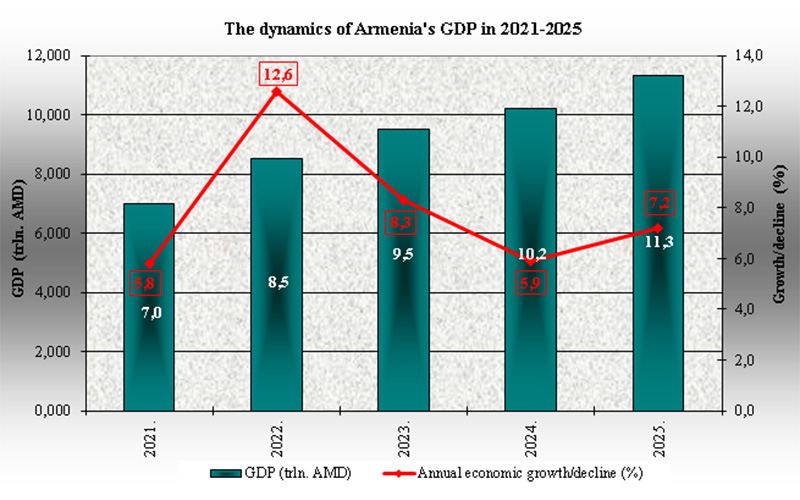
11.3 trillion drams in 2025), increasing in 2027 to 13.499-13.368 trillion drams. This is stated in the Central Bank of the Republic of Armenia’s September report, “Monetary Policy for Q3 2026.”
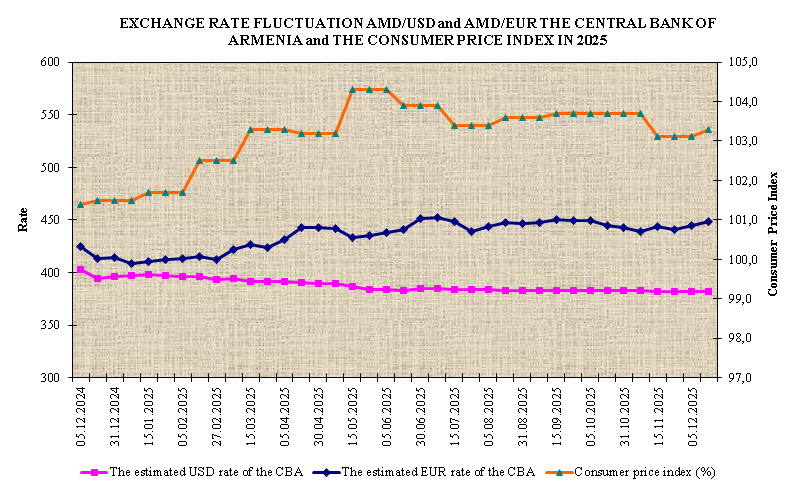
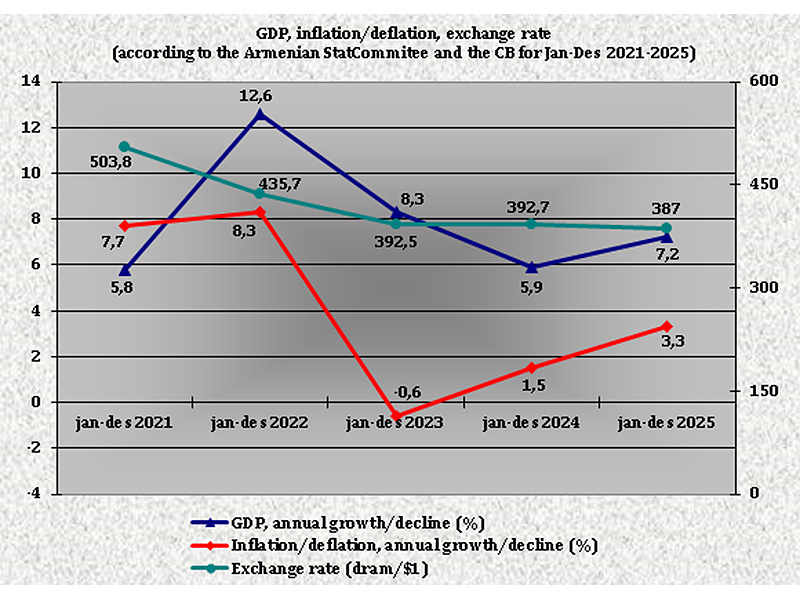
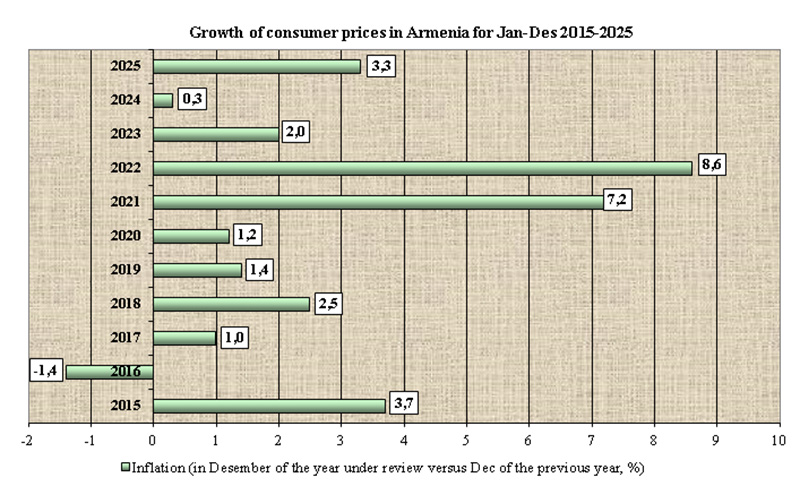
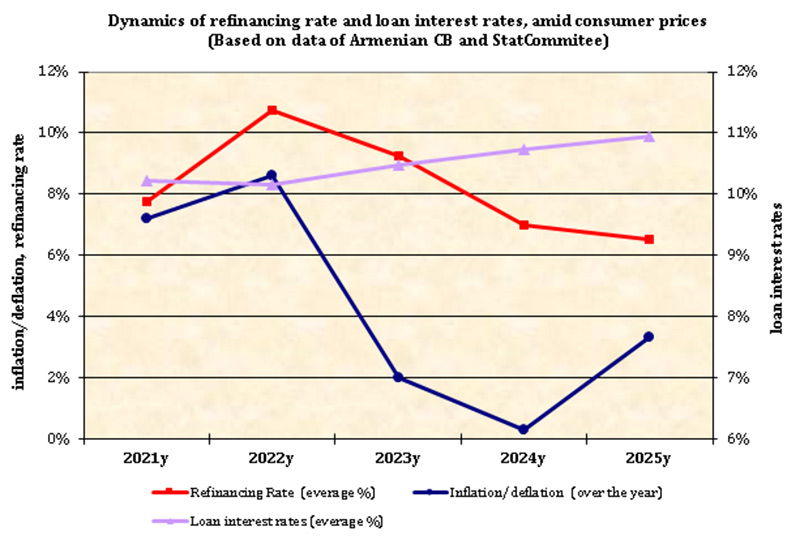
According to the Central Bank’s updated forecast, inflation in 2026 is expected to be in the range of 4.5-4.2% (versus the previously forecast 4.1-3.9% and actual inflation of 3.3% in 2025), against a target of 3% (+/-1 percentage point), while for 2027 it is forecast at 3.4-2.7% (versus the previously forecast 3.6-2.9%). Moreover, inflation in the segment of non-exportable goods, characterized by rigid prices, will rise more noticeably in 2026 under the new forecast—to 3.8-3.7% (from 2.2% in 2025), compared with the previously forecast 3.5-3.4%, with an insignificant retreat in 2027 to 4.7-3.5% (versus the previously forecast 3.5-2.7%).
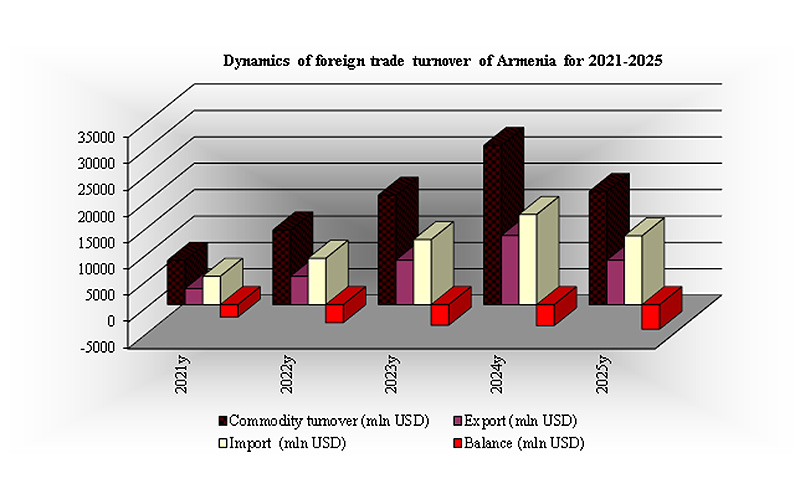
According to the Central Bank’s updated forecast, export and import dynamics, after the acceleration of the decline in 2025 to 30.1-27.2% (from 11-3.2% in 2024), will remain in double-digit decline in 2026—29.9-37.6% for exports and up to 25.8-30.2% for imports—whereas the previous forecast expected a noticeable slowdown in the decline, both in exports to 5.9-5.1% and in imports to 4.2-5.8%. According to the Central Bank’s expectations, foreign trade growth will resume in 2027, with rates being more substantial—5.5-7.7% for exports and 1.8-2% for imports—than previously forecast, at 2.6-4.3% for exports and 1.1-0.8% for imports.
According to the Central Bank’s new forecast, the current-account deficit-to-GDP ratio will decline in 2026 to 6.4-8.3% (after actually rising in 2025 from 6.2% to 8.7%), and the updated range does not differ significantly from the previous forecast of 6.5-5.7%. The decline in this indicator will continue in 2027, to negative 5.5-7.7% (versus the previously forecast 5.5-4.3%).
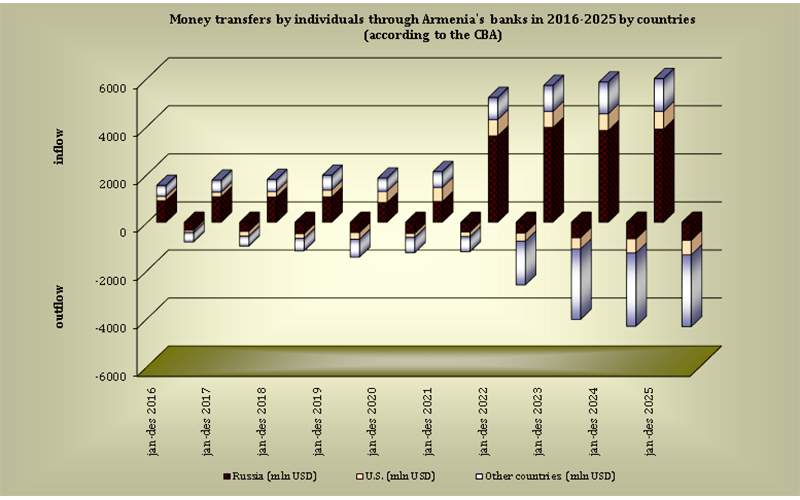
According to the Central Bank’s updated forecast, the remittances-to-GDP ratio will rise in 2026 to 3.4% (after actually declining in 2025 from 3.5% to 0.6%), and will continue to grow in 2027—to 3.8-3.7%—which nevertheless indicates a weak economic effect in terms of the impact of transfers on the economy.
The Central Bank’s forecast for budget revenues and expenditures in 2026 is as follows: expenditures will grow more noticeably—from 3.3 trillion to 3.6 trillion drams—than revenues, which will increase from 2.9 trillion to 3.1 trillion drams, resulting in the state budget deficit rising from 419.3 billion to 495.3 billion drams. As a result, in 2026 the state budget deficit-to-GDP ratio will rise from 3.7% to 4%, while the shares of both revenues in GDP, from 25.5% to 25.2-25.3%, and expenditures in GDP, from 23.1% to 29.2-29.3%, will decline. In 2027, revenues will rise to 3.5 trillion drams, while expenditures will increase to 3.9 trillion drams, reducing the deficit to 441.9 billion drams. The state budget deficit-to-GDP ratio will decline to 3.3% in 2027, while the share of revenues in GDP will rise to 25.7-26% and the share of expenditures in GDP will change insignificantly, to 29-29.3%.
This report by the Central Bank of the Republic of Armenia also updates forecasts for economic development and inflation dynamics in the United States, the eurozone and the Russian Federation, as well as for oil and copper prices and the FAO index. Thus, the US economy is expected to maintain growth at 2.2% in 2026 (the same as in 2025—2.2%) and inflation is expected to accelerate to 3.2% (from 2.7% in 2025). The eurozone economy will slow its growth to 1% in 2026 (from 1.4% in 2025), while inflation will accelerate to 2.7% (from 2.4% in 2025). The Russian economy will stall at 0.9% growth in 2026 (from 1% in 2025), while inflation will decline to 5.8% (from 9% in 2025). In 2027, US economic growth will slow to 2%, while growth in the eurozone and Russia will accelerate to the same level of 1.3%; inflation in the US and eurozone will decline to the same level of 2.6%, while in Russia it will continue to move downward, to 5.2%. According to the Central Bank’s new forecast, the price of oil will rise from $69.1 in 2025 to $87.8 per barrel in 2026, but will decline to $74.1 in 2027. The price of copper will continue to grow in 2026—to $14211 per ton (from $9947 per ton in 2025)—but will then decline slightly in 2027, to $14200.3 per ton. The FAO index, after rising from 122 to 127.2 in 2025, will continue to grow in 2026—to 132.1—while this trend will continue in 2027, reaching 135.8, and will subsequently continue moving upward, to 139.3 in 2028 and 143 in 2029.
It should be noted that the International Monetary Fund, having updated its forecast in June, did not change its expectations for Armenia’s GDP growth, predicting a slowdown to 5.3% in 2026, with an insignificant acceleration to 5.5% in 2027. The World Bank (WB), in its July forecast, also maintained its expectations for Armenia’s GDP growth in 2026 and 2027, predicting a slowdown to 5.3% and 5.1%, respectively. The European Bank for Reconstruction and Development (EBRD), updating its forecast in early June, expects identical 5.5% GDP growth in Armenia in 2026 and 2027. In its forecast updated in August of this year, S&P Global Ratings announced a slowdown in Armenia’s GDP growth to 4.9% in 2026, with an insignificant acceleration to 5.1% in 2027. In its forecast updated in July of this year, Fitch Ratings expects Armenia’s economic growth to slow to 5.2% in 2026, with growth stabilizing at around 5% over the medium term. In July of this year, the Moody's rating agency announced a forecast according to which Armenia’s real GDP growth in 2026 and 2027 will amount to 5-5.5%. The Asian Development Bank (ADB), in its April forecast, predicted 5.5% GDP growth for Armenia in 2026, accelerating to 5.7% in 2027. Armenia’s draft state budget for 2026 projects GDP growth of 5.4%, to 11.9 trillion drams (more than $32.2 billion).
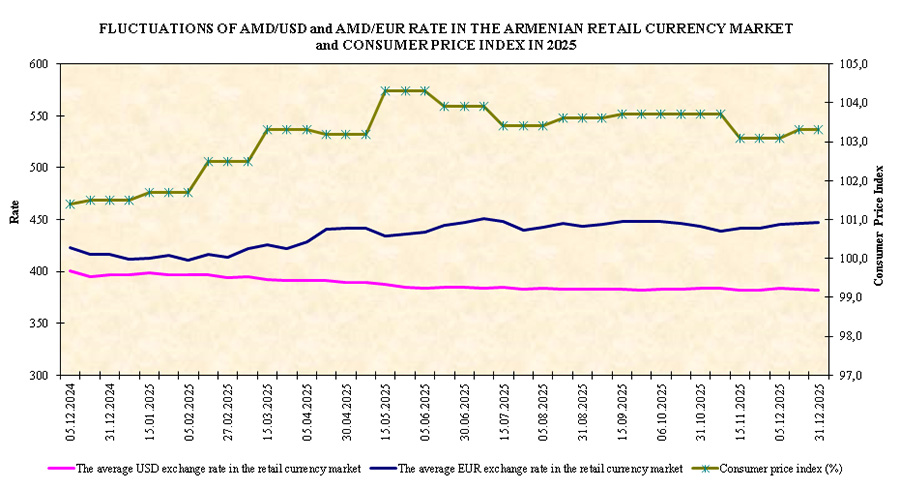
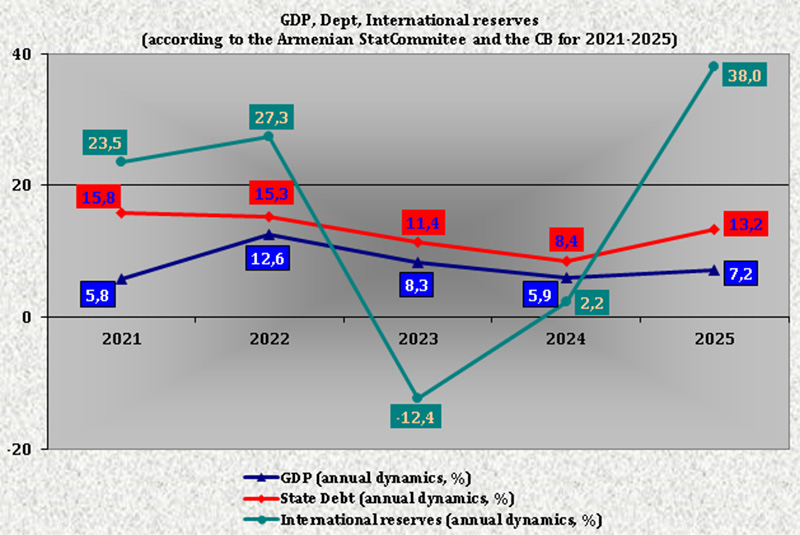
According to the Statistical Committee of the Republic of Armenia, Armenia’s GDP growth, after accelerating from 5.8% to 12.6% in 2022, began slowing in 2023 to 8.3% and then in 2024 to 5.9%, after which growth accelerated to 7.1% in 2025, reaching 11.343 trillion drams in absolute terms (more than $29.3 billion). The GDP deflator index, after rising from 106.9% to 108% in 2022, also began declining, to 103.1% in 2023 and 101.9% in 2024, before rising to 103.4% in 2025. (The average dram exchange rate against the US dollar for January-December 2025 was 387.01
drams/$1). It should be recalled that, following its transition to a new improved system for developing monetary policy (FPAS MARK II), the Central Bank has since 2024 calculated GDP forecasts according to the Case A and Case B scenarios. The Case A scenarios assume monetary policy rates exceeding market expectations, given that risk and uncertainty factors may create a more highly inflationary environment in the economy. The Case B scenarios, meanwhile, assume monetary policy rates lower than market expectations, given that risk and uncertainty factors may create a deflationary or low-inflation environment in the economy. Moreover, the Case A scenarios envisage expanding demand and restraining supply, while the Case B scenarios, conversely, envisage restraining demand and expanding supply.