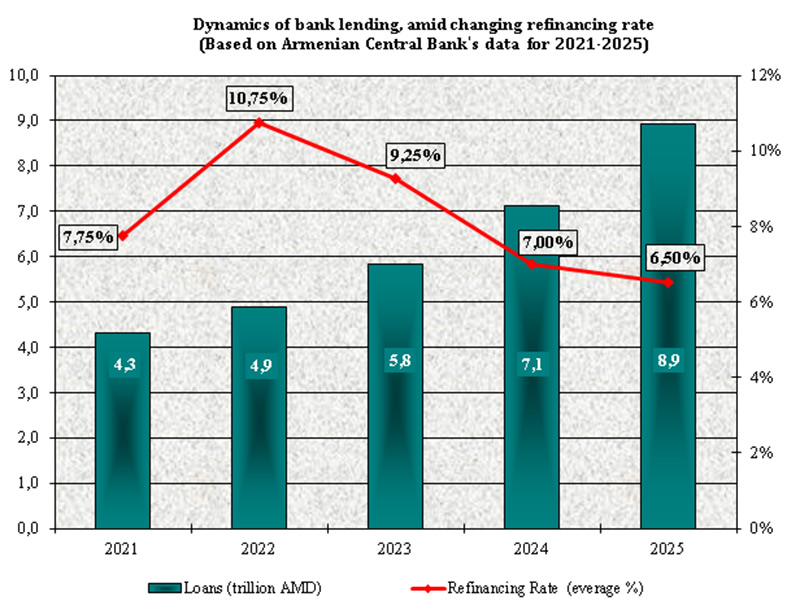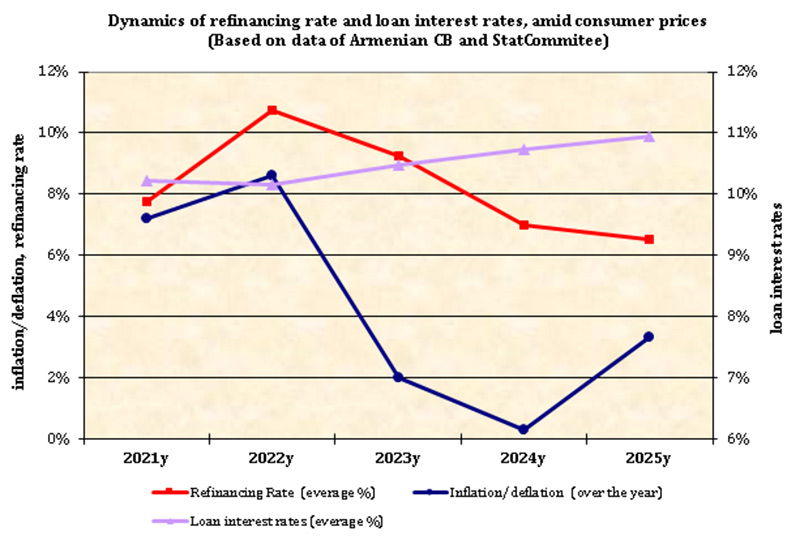


ArmInfo. Armenia's short-term country risk premium continued to decline, reaching a historically low level. This was stated by Martyn Galstyan, Chairman of the Central Bank of Armenia, while presenting the rationale for the Central Bank Board's decision to raise the refinancing rate from 6.5% to 6.75% at a press conference on September 15.
He explained that this reflects both the general trend of declining risk premiums in developing countries (including in the context of high global liquidity and growing investor appetite for risky assets) and the influence of factors specific to Armenia, including improved fundamentals and the perception of reduced security risks around Armenia.
The Central Bank's rationale notes that following the June 2026 decision of the Central Bank Board, the yield curve has shifted slightly downwards, which is likely due to both a decrease in the supply of government bonds and, in particular, increased interest in Armenian government bonds from non-residents. The latter is likely also linked to the fundamental decline in Armenia's country risk premium.
Amid the protracted nature of regional conflicts and their slight expansion, the risks of further weakening demand in the global economy and, at the same time, increasing inflationary pressures are gradually becoming more palpable. High investment activity in the US and growing concerns about fiscal stability have created risks of a possible rise in long-term neutral interest rates, with a corresponding impact on neutral rates and capital flows in developing countries. In the Eurozone and Russia, despite a weak recovery in economic growth in the second quarter, structural problems are deepening, which is also leading to a deterioration in medium-term growth prospects. Amid rising tensions in the Middle East, energy prices remained high, and the gradual decline in accumulated inventories increases market vulnerability to potential new supply shocks. In this context, the risks of further hikes in key interest rates by leading central banks and their prolonged maintenance at high levels have become more apparent.
In the second quarter of 2026, economic growth in Armenia accelerated, reaching above the long-term stable level. High economic growth continued to be largely driven by developments in the construction and services sectors, indicating excess demand. This is also reflected in high growth rates for retail trade and imports of final consumer goods. Moreover, there are signs of expanding external demand, primarily reflected in a significant increase in visits to Armenia. This also creates significant risks of accelerated growth in wages and service prices in these sectors. On the other hand, due to export restrictions to Russia, risks of excess supply in the domestic market and weakening consumer and investor confidence remain.
Given the discussed risks and existing uncertainties, the Council considered, on the one hand, Type A scenarios associated with the presence of higher demand conditions in the domestic economy, further expansion of external demand, and risks of rising inflation expectations, which require a higher refinancing rate trajectory compared to market expectations. On the other hand, the Council discussed Type B scenarios associated with the prospect of a slowdown in global economic growth, the development of deflationary risks due to export restrictions to Russia, and a fundamental decline in Armenia's country risk premium, which imply a lower refinancing rate trajectory compared to market expectations. As a result, emphasizing the importance of managing the macroeconomic implications of Type A scenarios, the Central Bank Board decided to increase the key interest rate by 0.25 percentage points, setting it at 6.75%. The Central Bank Board will continue to monitor economic development scenarios and is prepared to take proportionate actions to ensure the 3% inflation target and price stability in the medium term.
Domestic Demand
In Q2 2026, economic growth in Armenia accelerated slightly, reaching above the estimated long-term stable level of 6.7% year-on-year. However, the growth structure is quite heterogeneous. Due to the postponement of the season due to unfavorable weather conditions and export restrictions to Russia, agricultural production declined by 15.3% year-on-year, dampening economic growth by approximately 1 percentage point. These restrictions also pose risks to medium-term growth and export prospects for the manufacturing industry, which have recently weakened somewhat due to disruptions to trade routes in the Middle East.
On the other hand, alongside investment in AI (artificial intelligence) and gradual, closer integration into global IT infrastructures, ICT (information and communications technology) growth accelerated in the second quarter, reaching 15%. It is also worth noting that several AI factories have been commissioned in recent months, with the aim of significantly expanding production and exports in the coming years. Although these processes will have a limited impact on domestic value added during the construction phase due to their high capital intensity, during the operational phase—depending on how effectively the country's economy utilizes these opportunities—they could make a significant positive contribution to increasing Armenia's economic potential.
Nevertheless, economic growth continued to be driven primarily by successes in the services and construction sectors. In particular, the outpacing growth of the construction sector in recent months has been accompanied by a sharp increase in real estate prices, while growth in the services sector is more widespread.
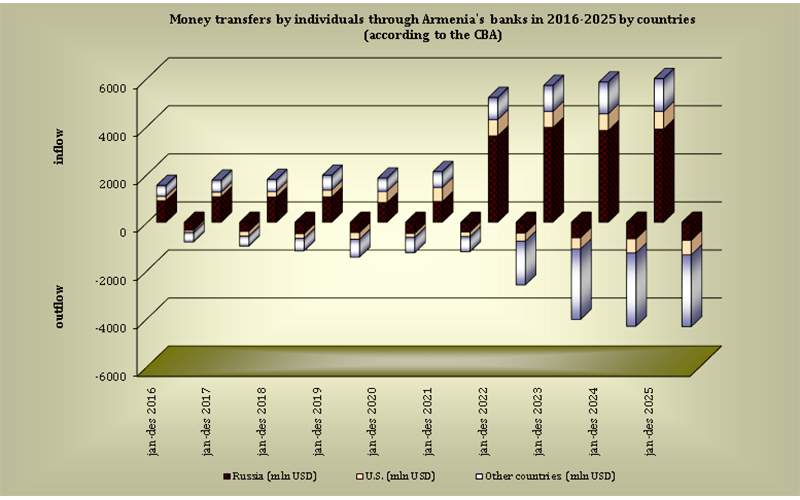
These processes apparently primarily reflect a significant increase in visits from Russia to Armenia. Despite the recent weakening of tourist flows, amid growing uncertainty surrounding the security situation and economic prospects in Russia, there has been a noticeable increase in trips by Russian citizens to Armenia. On the other hand, high uncertainty surrounding the medium-term prospects of the Russian economy and a tightening of migration policy could curb seasonal labor migration from Armenia to Russia and reduce remittances, posing risks of weakening domestic demand.
During 2026, strong economic growth, a broadening inflationary environment, and some improvement in administration contributed to high tax revenue performance. However, capital expenditures are performing significantly lower than historical trends. Specifically, in January-July 2026, capital expenditures decreased by approximately 26.6% year-on-year, primarily due to a reduction in defense spending. However, the planned reduction in this area of expenditure creates uncertainty regarding future capital expenditures and their impact on the economy. At the same time, the risk of overspending on social spending, particularly on the universal health insurance system, has increased. As of January-June 2026, spending in this area amounted to approximately 80% of the planned volume for the entire year, and the circle of insured persons has expanded.
Relatively more balanced conditions are emerging in the labor market
Despite the continued high level of uncertainty, a number of indicators may indicate the emergence of relatively more balanced conditions in the labor market. The unemployment rate in Armenia continues to fluctuate between 12% and 14%, while the number of officially registered workers is growing at a steady pace, likely indicating a shift from informal employment to the formal sector.
Nominal wage growth in the private sector (excluding the financial sector) continues to stabilize, remaining within the 6%-7% year-on-year range. However, alongside accelerated growth in certain service sector subsectors in recent months, a decline in the concentration of wage growth in this sector may indicate expanding demand conditions. The recent increase in the number of non-resident workers may also indicate the presence of potential excess demand, somewhat masking the resulting inflationary pressures. On the other hand, the tightening of Russia's migration policy and the uncertainty surrounding its economic prospects in the near future could not only limit the outflow of labor to Russia for work but also create the preconditions for an influx of labor from Russia.
The acceleration of core inflation, in addition to supply-side factors, indicates strong demand.
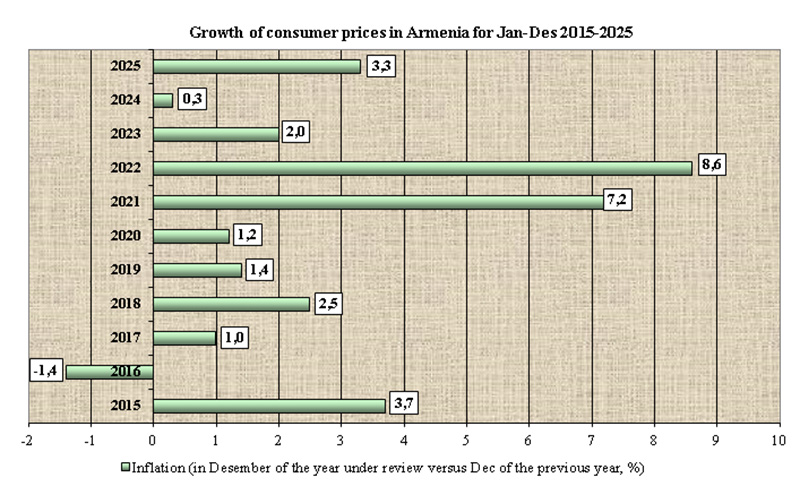
In Armenia, annual inflation slowed somewhat in Q3 2026 but continued to rise above the target level, reaching 4.4% y/y in August. This is primarily due to deeper deflationary effects on certain goods due to export restrictions to Russia. However, certain government support programs and low harvests for certain agricultural crops could limit the full manifestation of these trends. Core inflation accelerated slightly, reaching 4.8% y/y in August, primarily reflecting rising prices for local off-season food products. However, the impact of volatile global commodity and energy prices, as well as disruptions to trade routes, could still be passed on to domestic prices.
At the same time, the acceleration of core inflation in recent months has been more widespread, which, in addition to supply factors, likely indicates the emergence of strong demand conditions. The growth of the hard price index for non-tradable goods also accelerated slightly in August, primarily due to rising housing rents, which is consistent with a revival in external demand. It is also worth noting that a gradual transfer of these processes to services, which are characterized by more rigid prices, is also observed. Nevertheless, the share of goods and services with variable prices in the general inflation baskets and the index of fixed prices for non-tradable goods remains within historical averages, which apparently indicates stabilization of inflation expectations.
High uncertainty remains around global economic growth prospects
High uncertainty remains around global economic growth prospects in Q3 2026. On the one hand, persistent geopolitical tensions in the Middle East, their slight expansion, and ongoing disruptions to trade routes support the risks of high energy prices and volatility, as well as further weakening of economic growth. On the other hand, increased investment activity, driven by optimistic expectations regarding the development of AI (artificial intelligence), Particularly in the US, this somewhat offsets these negative effects.
USA. Amidst significant geopolitical uncertainty and ongoing transformations in economic, particularly trade, policy, US economic growth has demonstrated significant volatility in recent quarters: it has slowed somewhat recently and amounted to 1.5% y/y in Q2 2026. However, domestic demand has remained relatively strong, and private consumption and fixed capital investment—especially AI-related technology and infrastructure investment—continue to be the main drivers of economic growth. At the same time, uncertainty surrounding the length of the AI investment cycle and the effectiveness of its application, as well as potential price adjustments in financial assets, pose downside risks to economic growth and demand prospects.
Risks associated with fiscal stability in the US are gradually being priced into financial markets. The rebate resulting from the elimination of some tariffs, especially when combined with the need for additional defense spending, could entail additional risks of a widening budget deficit in the medium term. It is worth noting that, according to estimates by the Congressional Budget Office, the US federal budget deficit in 2026, as in previous years, will be around 6% of GDP, which is significantly higher than historically recorded figures, especially during relatively stable times. These risks, although largely priced in by financial markets, still include the potential for a rise in the long-term neutral interest rate in the US, with a corresponding impact on neutral rates and capital flows in emerging markets.
In the US, both headline and core inflation continue to trend above target. At the same time, significant downside risks remain amid significant volatility and still-high global energy prices, as well as significant uncertainty surrounding their outlook. Under these conditions, financial markets expect a gradual increase in the key interest rate over the next year by approximately 75 basis points.
Eurozone. In the Eurozone as a whole, economic growth has remained stably low in recent quarters. However, uncertainty surrounding the medium-term outlook remains high. On the one hand, this is due to the accumulation of structural problems and the negative impact of the Middle East conflict, and on the other hand, to the revival of investment activity in the AI sector, the military-industrial sector, and infrastructure. With energy prices remaining high and supplies significantly vulnerable (especially due to low gas storage capacity), the risks of a broader inflationary environment are also increasing. As a result, financial markets are pricing in a gradual increase in the ECB's key rate by approximately 50 basis points over the course of the year.
Russia. In the second quarter of 2026, economic growth in Russia recovered somewhat, reaching 1.3% year-on-year. This growth was primarily driven by the development of trade and services, which also reflects the impact of stimulative fiscal policy. At the same time, the prolonged persistence of high oil prices is contributing to an increase in oil and gas revenues and a slight expansion of fiscal space. This creates opportunities for additional stimulus for economic activity in the short term.
On the other hand, structural problems persist in certain sectors of the economy, as well as risks of a deteriorating security situation. Labor market conditions remain tight, and migration policy carries the risk of further constraining labor supply. Inflationary pressure has increased again, including due to disruptions in fuel production and damage to warehouses, while inflation expectations continue to hover at high levels. Under these conditions, a high inflationary environment, on the one hand, and weakening economic growth, along with the risks of deepening structural problems in certain sectors, on the other, complicate the Central Bank of Russia's effective management of the dilemma between inflation and economic growth.
Global oil prices rose again
Along with the intensification of tensions in the Middle East, global oil prices rose again, reaching significantly higher levels than at the beginning of the year. Moreover, due to the significant drawdown of strategic oil reserves, particularly in leading economies, the global economy's vulnerability to new oil supply shocks has increased. On the other hand, the continued expansion of supply from non-OPEC+ countries could mitigate the impact of such developments. High energy prices, as well as disruptions to trade routes and supply chains amid escalating regional conflicts, could also contribute to further increases in food prices, particularly for grains, vegetable oils, and sugar.