

ArmInfo. Armenia's GDP for the first half of 2026 stood at 5.167 trillion drams (exceeding $13.8 billion), growing from 2.332 trillion drams in the first quarter to 2.835 trillion drams in the second quarter. According to data from the Statistical Committee of the Republic of Armenia, the annual GDP growth accelerated in the second quarter to 6.7% (up from 5.9% a year ago), with a much more significant increase in the reporting quarter alone – by 19.2%. Meanwhile, the GDP deflator index increased annually to 104.2% in Q2 2026 (from 102.4% in Q2 2025).
Specifically, within the GDP structure, annual growth accelerated in the construction sector – from 18.5% to 24.5%, the service sector – from 9.8% to 11%, and the energy sector – from 4% to 10%. The industrial sector's annual growth improved, recovering from a 12.1% decline to 10.8% growth. In particular, the mining sector accelerated significantly, from a stagnant 0.6% to a double-digit 28.9%, while manufacturing recovered from a 19.1% decline to 7.4% growth. Meanwhile, the leading trade sector by volume continued to decline in growth, from 3.9% to a nearly stagnant 0.9%. The agricultural sector, meanwhile, worsened its annual performance, shifting from 7.3% growth to a double-digit 11.9% decline. Moreover, in the industrial sector, this activity in the mining industry was driven by strong growth in metal ore production – by 32.5%, while in the manufacturing industry, impressive increases in production volumes were observed in the chemical industry – by 73.2%, the metallurgical industry – by 32.1%, the production of finished metal products – by 34.2%, and furniture – by 59.7%.
The trade sector continues to lead in volume with 3.2 trillion drams ($8.4 billion), followed by the services sector with 2.2 trillion drams ($8.4 billion). AMD ($5.7 billion), and the industrial sector ranked third with AMD 1.5 trillion ($4.1 billion). Fourth place goes to the agricultural sector with AMD 310.1 billion ($828.3 million), and fifth to the construction sector with AMD 282.2 billion ($754 million). Electricity generation in the first half of 2026 amounted to 5,163.7 million kWh.
GDP per capita increased year-on-year (Q2 2026 vs. Q2 2025) from AMD 817,783 thousand ($2,112 thousand) to AMD 913,892 thousand ($2,468 thousand). This was observed against the backdrop of a slight slowdown in Armenia's annual population growth from 0.9% (26,600 people) to 0.6% (19,500 people), i.e., from 3.084 million to 3.104 million.
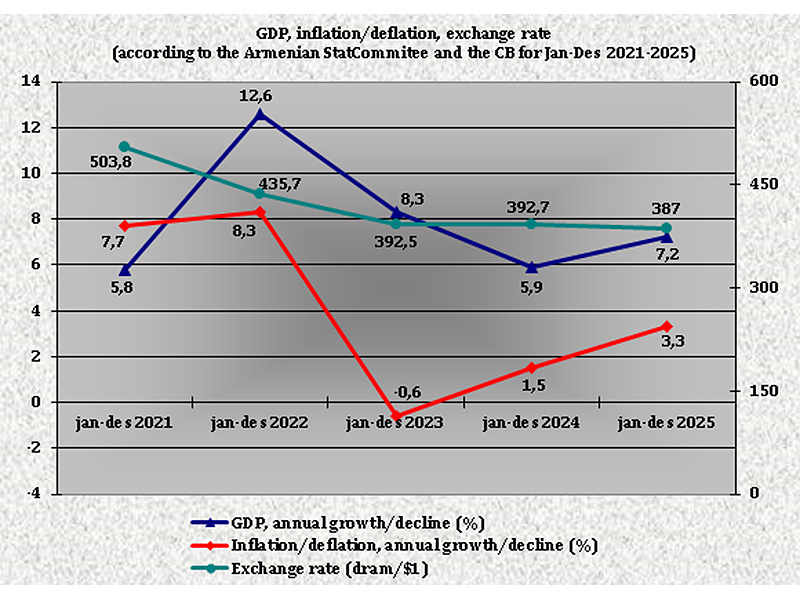
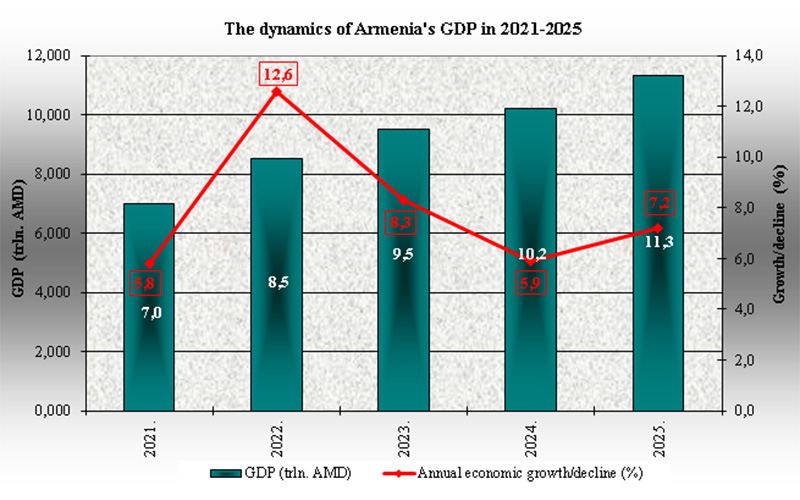
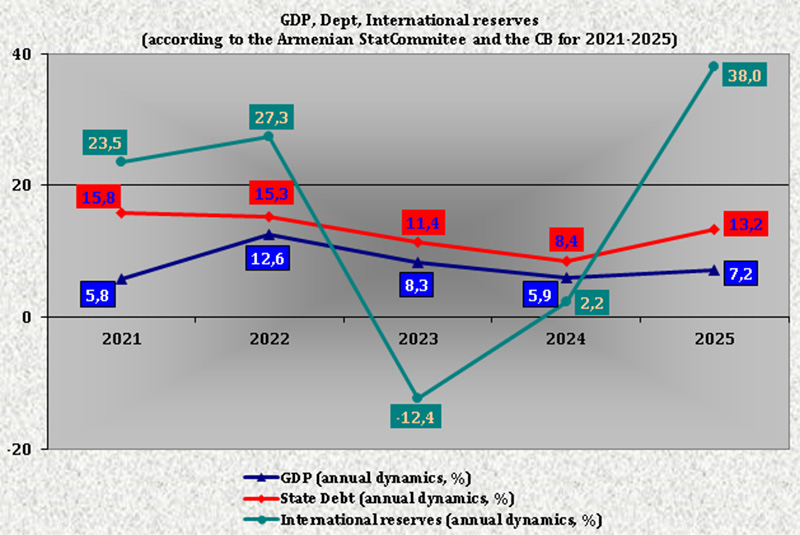
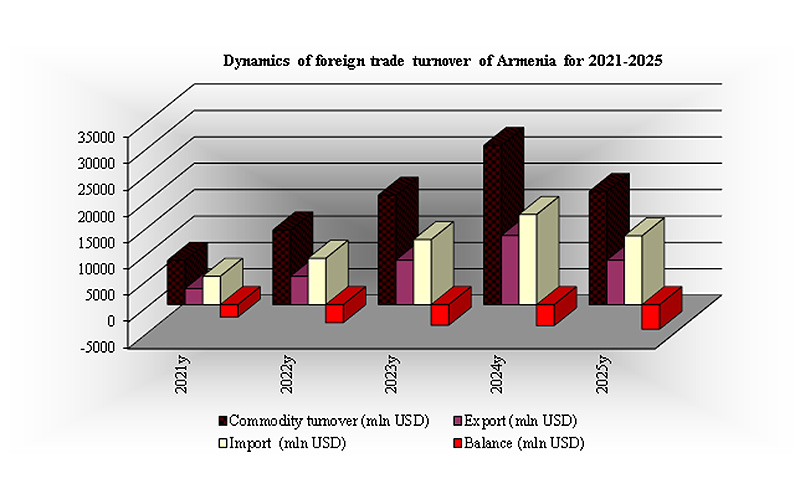
Armenia's foreign trade turnover in H1 2026 significantly slowed in annual decline to 0.1% (from 45% a year ago), amounting to $9.6 billion. This resulted from an improvement in import dynamics from a 38.6% decline to 4% growth and a noticeable slowdown in the decline in exports from 52.8% to 6.7%. The absolute values of these exports for the first half of 2026 amounted to $3.4 billion and $6.1 billion, respectively. It should be noted that both the IMF and the World Bank forecast a slowdown in Armenia's GDP growth rate in 2026 to 5.3%. The Central Bank of Armenia forecasts a more noticeable slowdown in GDP growth for 2026, to 4.5-4.1%. According to the Statistical Committee of the Republic of Armenia, Armenia's GDP, after a slowdown in growth in 2022-2024 from 12.6% to 5.9%, accelerated to 7.1% in 2025, exceeding 11.3 trillion drams (over $29.3 billion) in absolute terms. The GDP deflator index also increased to 103.6% in 2025, after dropping from 106.9% to 101.4% in 2022-2024. At the same time, the Central Bank and the IMF's forecasts for exports and imports in 2026 differ significantly. According to the Central Bank of Armenia's forecast, updated in June of this year, export and import dynamics will remain in decline in 2026, with rates slowing to 5.9-5.1% (for exports) and 4.2-5.8% (for imports). The Central Bank expects foreign trade growth to resume in 2027: exports by 2.6-4.3% and imports by 1.1-0.8%. The International Monetary Fund, in its June forecast, indicated a modest improvement in Armenia's export and import dynamics in 2026, expecting a recovery from a double-digit decline to a very weak and almost flat growth of 0.9-0.7% (compared to the previously projected 2.2-2.1%). However, the IMF significantly improved its forecast for export and import growth in 2027, to 5.5-6.3% (compared to the previously forecasted 3.4- 3.7%). In its July forecast, the World Bank did not indicate the potential dynamics of Armenia's foreign trade in 2026-2028, but noted that the current account deficit to GDP ratio, after a significant increase in 2025 from 4.6% to 7.2%, would gradually decline to 5.6% in 2026, 5.2% in 2027, and 4.8% in 2028, driven by normalized trade flows and increased export potential.