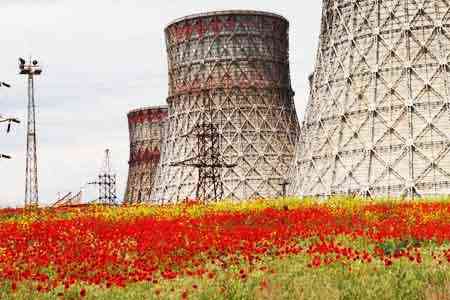


ArmInfo. Baku and Ankara's demands to close the Armenian Nuclear Power Plant have a long history, but while previouslyAzerbaijanis tearfully proposed closing the Armenian Nuclear Power Plant at international forums, now they are making this demand confidently and authoritatively. Artak Zakaryan, a member of the board of the Republican Party, writes about this in his article.
According to him, Azerbaijani President Ilham Aliyev is so confident in the resolution of the nuclear power plant closure in Armenia that he is even offering Yerevan a solution to its electricity shortage, making Yerevan unilaterally dependent on Baku. "Back in 2024, Azerbaijan's Energy Minister announced its intention to build a nuclear power plant in Absheron, on the Caspian Sea. Aliyev also didn't rule this out. Considering the potential for transit of not only transport but also energy resources under the American auspices of the TRIP project, it can be assumed that Azerbaijan is also seeking to become the leading energy supplier in the South Caucasus. And the West is trying to exploit this. Meanwhile, Armenia is seeking to remove Russia from all spheres of influence in the South Caucasus. Clearly, the closure of the Armenian NPP is inconsistent with the country's energy strategy, which envisages extending the operation of the existing power unit until 2036 and using this period to transition to a new nuclear model. Armenia has always been committed to preserving nuclear energy as a key component of the country's energy security," the politician noted.
He recalled that in April 2016, the Russian government stated that Rosatom was prepared to extend the operation of the Armenian NPP until 2036, provided that the Russian nuclear corporation would be awarded 70% of the work. Earlier, in February 2026, US Vice President Vance announced the potential American investment in Armenia's nuclear energy sector. Consequently, a nuclear cooperation agreement was signed, paving the way for future projects. "Regardless of current regional developments, Armenia must preserve nuclear energy as a key component of the country's security. When selecting a new power unit, it is imperative to focus on a reliable and long-term partnership with a technologically proven and safely operated plant. Moreover, according to experts, there are still no proven and successfully operating modular nuclear power plants. The Metsamor NPP is still 10 years away from safe operation, and there is no need to make hasty decisions under political pressure. The Armenian NPP is truly critical: it provides approximately one-third of Armenia's electricity production. Shutting it down without timely provision of replacement capacity would pose a serious risk to the energy system. Therefore, the state strategy should not foresee a abandonment of nuclear energy, but rather the replacement of existing capacity with new ones. Moreover, the IAEA sees no problems with Armenia's nuclear safety programs," Artak Zakaryan emphasized
Recall, Armenian Prime Minister Nikol Pashinyan previously stated that there are opportunities to extend the life of Unit 2 of the Armenian Nuclear Power Plant for another 10 years beyond 2036. He noted that the plant is currently in the process of extending the life of Unit 2 until 2036. With another 10 years, the unit will be able to operate until 2046. A decision on a new plant must be made during this period. Nuclear reactor models proposed by Russia, the United States, France, China, and South Korea are being studied. "We are conducting transparent negotiations with all partners. Our decision, which will be strategic in nature, must be based on the most advantageous offer that meets the interests of the country," the head of government said.
He emphasized the importance of conducting research into the international nuclear technology market. Pashinyan noted that the current tariff for electricity generated at the Armenian Nuclear Power Plant is the lowest in the country. However, as the prime minister pointed out, the world's current nuclear fuel reserves are sufficient for 70 years. Therefore, it is crucial to know the cost of 1 kWh of electricity in 40 years. This raises the question of economic feasibility and the potential for recouping investment. However, as the Prime Minister stated, there is already experience with re-enriching used fuel. In any case, Pashinyan emphasized, the issue must be addressed at cost.
Note, since May 2026, the Armenian Nuclear Power Plant has been shut down for a five-month scheduled maintenance. During this period, the main work will be carried out under the second life extension program for Unit 2 of the Armenian Nuclear Power Plant. $165 million saved from the first extension program will be used to address this issue. Previously, the country's authorities announced the adoption of a conceptual decision to build a nuclear power plant with small modular reactors.