

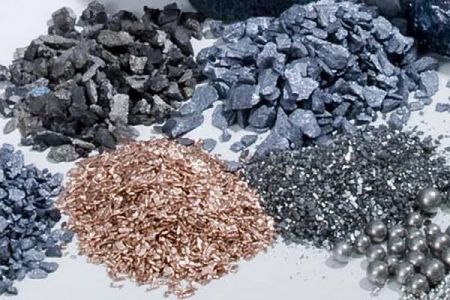
ArmInfo. Armenia's dominant export, mineral raw materials, has increased significantly in volume, while its main import, machinery and equipment, has achieved double- digit growth from stagnation. This is evidenced by data from the Statistical Committee of the Republic of Armenia for the first half of 2026.
The second, third, and fourth positions in exports are occupied by finished food products, precious metals/stones, and machinery, while the imports include land/air/water transport, mineral raw materials, and finished food products. Textiles are fifth in exports, while chemical products are in imports.
Overall, the top five categories account for 82.2% of exports ($2.8 billion) and 63.1% of imports ($3.9 billion). Moreover, precious metals and stones continue to decline significantly in both exports and imports, having lost their leading position in imports last year to machinery and equipment, and now yielding their leading position in exports to mineral raw materials.
During the reporting period, mineral raw materials were exported for $931.4 million (27.1% of the total), finished food products for $594.8 million (17.3%), precious metals and stones for $588.8 million (17.1%), machinery and equipment for $553.3 million (16.1%), and textiles for $153.4 million (4.5%). Machinery and equipment imported amounted to $1.5 billion (24.5%), land/air/water transport to $724.6 million (11.8%), mineral raw materials to $687.3 million (11.2%), finished food products to $525.2 million (8.6%), and chemical products to $427.8 million (7%).
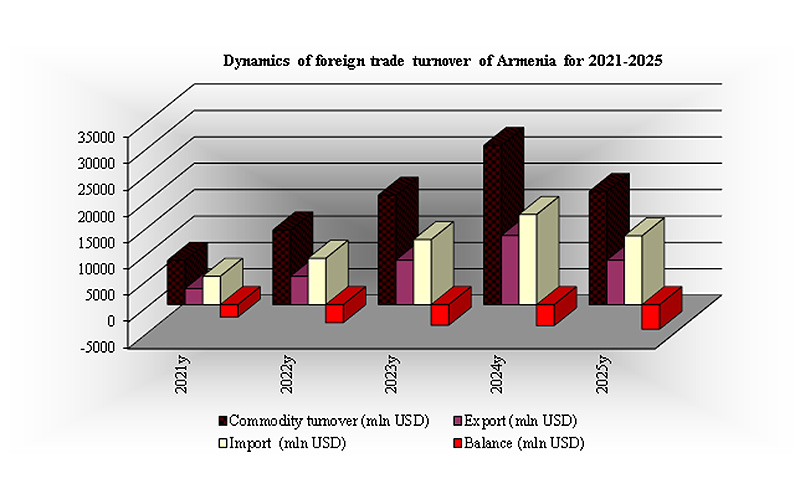
Let's look at the year-over-year dynamics of these goods in terms of exports and imports. Specifically, mineral raw material exports accelerated significantly, reaching a significant 80.3%, while import growth accelerated to 23.1%. Finished food imports grew even faster, reaching 37.2%, while export growth slowed to 5.2%. Machinery and equipment recovered from stagnation in imports by 24.6%, while slowing the decline in exports to a mere 0.1%. Precious metals and stones declined significantly in both exports and imports, by 52.6% to 64.8%. Imports of land/air/water transport increased by 34.3% year-on-year, accelerating, while their significantly smaller exports recovered from the decline to double-digit growth of 29.3%. Textiles continued to decline in exports, but at a meager 1.7%, while remaining in decline in imports. Chemical products recovered from the decline to a strong double-digit growth of 37.4%, while maintaining moderate growth in exports. According to statistics, total exports in the first half of 2026 exceeded $3.4 billion, while imports reached $6.1 billion. Exports remained in decline, but with an annual rate slowing from 52.8% to 6.7%, while imports rebounded from a 38.6% decline to 4% growth.
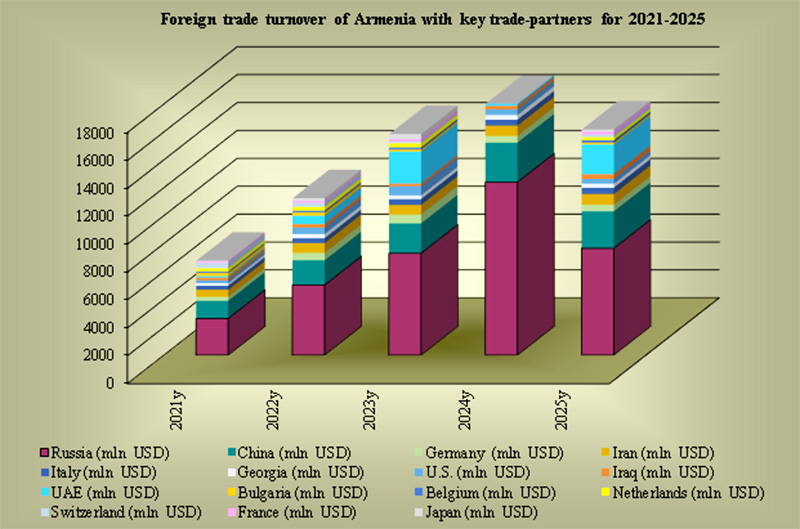
By country, exports and imports to the EAEU decreased by 4.2-28.8%, while increasing significantly to the EU by 80.2-35%. Exports to most EU countries increased significantly, and imports to some also increased. Export and import growth during the reporting period were also recorded for Brazil, the United Kingdom, and Canada. In China, an improvement in export dynamics, with a reversal of decline to significant growth, was accompanied by a sharp slowdown in import growth, while in the United States, the opposite pattern was observed: imports rebounded from decline to high double-digit growth, while the decline in exports accelerated.
Russia and China hold the top two positions in both exports and imports. The UAE, Bulgaria, and Iraq are next in the top five for exports, while Iran, the United States, and Germany are next in the top five for imports.