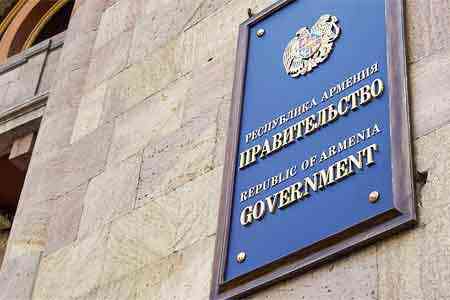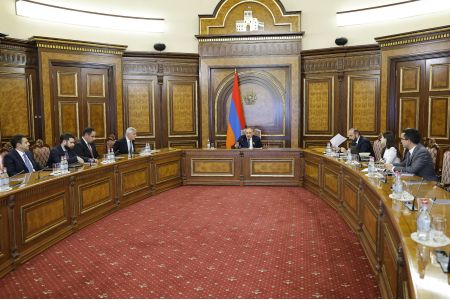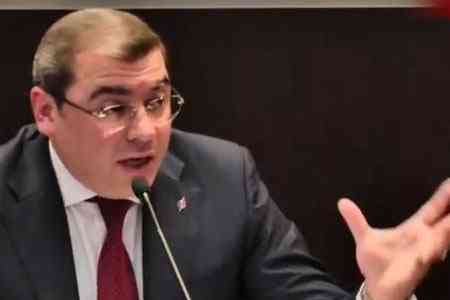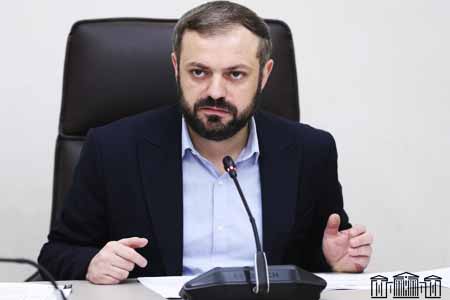


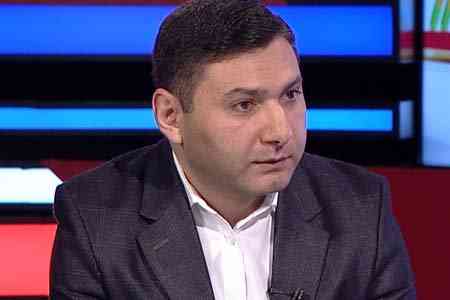
ArmInfo. The amendments to the Law "On the Structure and Activities of the Government" adopted by the Armenian Cabinet yesterday raise a number of problematic issues. Economist Haykaz Fanyan wrote about this on his Facebook page.
"This draft law forces me to react and draw attention to a number of circumstances. In particular, according to this draft, it is proposed to rename the Ministry of Foreign Affairs to the Ministry of Foreign Affairs and International Trade, assigning to the latter the functions of promoting foreign trade and ensuring access to export markets, supporting the attraction of foreign investment, and to the Ministry of Economy the functions of supporting the promotion of foreign trade and attracting investment. It sounds like a play on words, but the meaning is this: the policy in the field of promoting foreign trade is developed by the Ministry of Foreign Affairs with the support of the Ministry of Economy, the policy in the field of attracting investment is developed by the Ministry of Economy with the support of the Ministry of Foreign Affairs. I would like to express my disagreement with this situation, highlighting several important circumstances: do not change horses in midstream - in the near future, when the question of whether to remain in the EAEU is expected, the need for diversification is exacerbated, replacing one body with another in the field of export promotion policy is fraught with the risk of wasting time until the Ministry of Foreign Affairs forms the appropriate understanding and capabilities. As a result, we may lose about 2 years. In addition, the question of export promotion arises. This is not just the sale of goods, export includes This involves a great deal of preparatory work: developing exporters' potential, organizing familiarization trips for foreign partners to factories, establishing quality management systems, etc. By dividing functions between two structures, there's a high probability that neither the Ministry of Foreign Affairs nor the Ministry of Economy will bear responsibility, and failures in the process can be attributed to the shortcomings of the other. The expert also noted the lack of corresponding capabilities and interest in the diplomatic system. "Many years ago, in 2019 (if I'm not mistaken), I participated in a meeting of ambassadors where their participation in export and investment promotion functions was discussed, and the position of many of them was clear: we are not traders who seek clients for some businessman. Moreover, this could discredit our institution and undermine the performance of our core functions." In this regard, in my opinion, their function should be to attract potential clients, which until now has only been fully implemented by a few ambassadors, although during Karen Karapetyan's tenure, corresponding mechanisms were introduced for diplomatic missions as well," noted Haykaz Fanyan.
He also pointed out the problem of limiting the functions of the Ministry of Economy, one of whose key instruments is export promotion policy. The adoption of the document would result in the Minister of Economy being responsible for something for which he has insufficient authority.
Furthermore, the name of the ministry is inconsistent with its scope of work and functions, as there is no mention of imports, or more precisely, customs policy. "This begs the question: if this isn't related to customs policy, why did you call it 'international trade'? There are several countries where the foreign policy department is also responsible for foreign trade: Canada, New Zealand, Australia, Hungary. Moreover, in the last decade, a reverse process has been observed; for example, South Korea and the UK have switched from this unified model to a separate one. I don't know what prompted this decision, but we, the state, are once again finding ourselves in the same trap where ad hoc decisions are given more importance than the formation of systemic institutions (let me remind you that the EU provides financial support for this purpose), and we will once again face the same old trap: we wanted the best, but it turned out as always. In my opinion, these arguments are entirely justified for MPs, regardless of faction, to express their disagreement with this project by voting," the economist concluded.