


ArmInfo. Agricultural risk insurance is gaining momentum in Armenia, finally picking up in 2026 after two years of inactivity.
According to data from the National Agroinsurance Agency (AINA), by June 2026, a total of 9,528 contracts had been concluded, collecting 798.9 million drams ($2.2 million) in insurance premiums.
Of this amount, 56% (446.3 million drams) represents the share paid by insurance companies, while 44% (352.5 million drams) constitutes the subsidized portion. The total area of insured agricultural land has already reached 10,923 hectares.
Data from AINA idicates that by June 2026, the dominant share of insurance premiums (788 million drams, including 442 million from insurance companies and 346 million in subsidies) and the majority of contracts (9,407) apply to crops such as apricots, grapes, peaches, plums, grains, potatoes, sweet cherries, and sour cherries. With agro-insurance activity picking up in 2026 and steadily gathering pace month by month, these indicators have increased significantly. The primary risks covered include spring frosts, drought, hail, and fire.
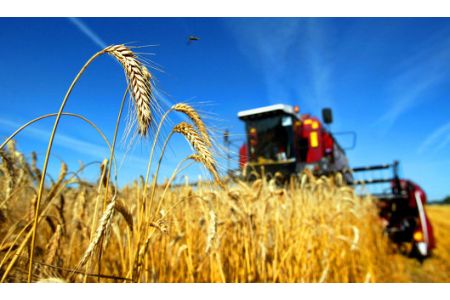
According to AINA, the largest area of insured land is used for grain crops and apricots – 8,391 hectares and 1,538 hectares, respectively. Specifically, the largest amounts of insured land are recorded in the following regions of Armenia: Shirak – 3,786 hectares. (almost entirely used for sowing grain crops), Lori - 2808 hectares (mainly for sowing grain crops and partially for planting potatoes), Armavir - 1608 hectares (mainly for growing apricots, much less for grapes, cherries, sour cherries and plums, and very little for sowing grain crops and planting potatoes), and Gegharkunik - 1407 hectares (mainly for sowing grain crops and the remaining small area for planting potatoes and growing apricots). In total, across all 10 regions of Armenia, 10923 hectares of the insured ones. The main area of land is used for sowing grain crops (8,391 hectares or 77%), much less for growing apricots (1,538 hectares or 14%), and even less for planting potatoes and growing grapes, plums, cherries, cherries and peaches (922 hectares or over 8%).
It's worth recalling that the agricultural risk insurance program launched in Armenia as a pilot program in September 2019, with policy sales beginning in 2020. The program's partners were Swiss Re, a major Swiss reinsurance company, and the German bank KfW (subsidized jointly with the Armenian government on a 50:50 pari passu basis). Moreover, of the EUR 5.3 million allocated by KfW for agricultural insurance, 2.6 million has already been transferred for subsidies until 2025. This program was in effect until issues with inadequate oversight of compensation payments, which exceeded the estimated damage amount, were identified in 2024. That same year, Swiss Re, a reinsurer, withdrew from the Armenian agricultural insurance market, and insurance companies were unable to fully cover the insurance risks, given the high losses caused by climate change. Since then, agricultural insurance has been stalled, and premiums have plummeted. Thus, while in 2023, insurance companies concluded 10,192 contracts and the volume of insurance premiums amounted to 1.8 billion drams, by 2024 only 27 contracts remained, and the volume of premiums had sharply decreased to 22 million drams. It was precisely because of the high loss ratio recorded in 2023 (with premiums of 1.8 billion drams, compensation amounted to 2.7 billion drams) that the reinsurance company Swiss Re left the Armenian market in 2024, and its functions were assumed by the Armenian government in order to reduce the risks of insurance companies.
However, the government's attempts to revive agricultural insurance, including raising the subsidy threshold from 50-60% to 70-80% in 2025 (if damages exceeded 200%, insurance companies were entitled to compensation for this portion as well), and assuming the "reinsurance function," have finally resulted in the program being reinstated in 2026. Furthermore, as of 2025, due to changes to the program, all agricultural crops (apricots, grapes, peaches, plums, apples, cherries, sour cherries, watermelons, melons, potatoes, and grain crops (wheat/barley/oats) are now covered by insurance against all types of risks without limitations (hail and fire, spring frosts and drought). And unlike previous years, when only three insurance companies (INGO, LIGA Insurance, and Sil Insurance) participated in the program, all seven insurance companies are now involved. The government's plans for 2026 include finding a foreign reinsurance company to partner with this program, and negotiations are underway.
However, according to AmRating analysts, the 200 million drams allocated for agricultural insurance in the 2026 state budget are unlikely to allow the Armenian government to fully fulfill its obligations, especially since global climate change is irreversible, and insurance companies, as previous years have shown, are unable to cover agricultural risks without reinsurance. Meanwhile, the World Bank has recommended systemic changes aimed at introducing an insurance component and launching a new, reformed program in 2027.