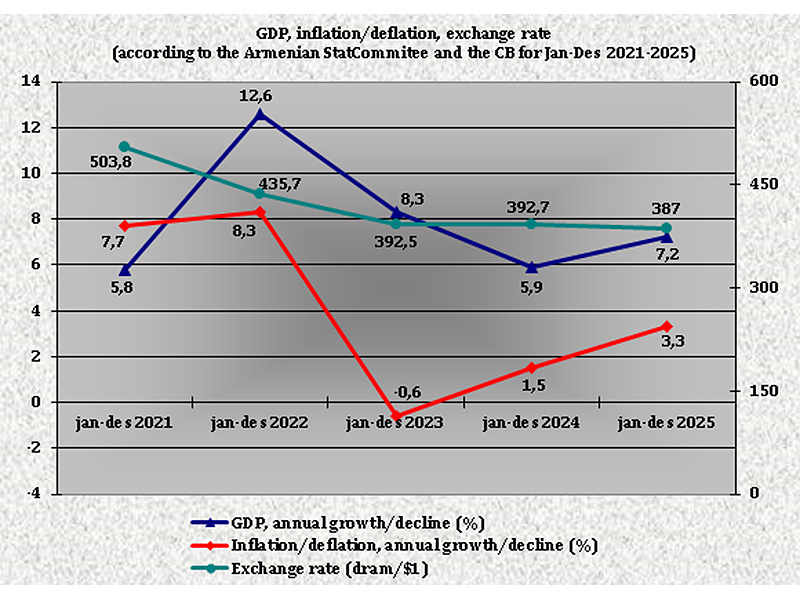


ArmInfo. In Armenia, annual inflation accelerated to 5.1% in June 2026, up from 3.9% a year ago. This was driven by a more pronounced increase in food prices - 8.5% (compared to 6.2% last year), a less noticeable increase in services - 2.4% (compared to 3.5% last year). At the same time, non-food prices increased by 2.3% (compared to a 0.2% decrease the previous year). This is according to data from the RA Statistical Committee.
Moreover, among food products, the most noticeable price increases in the year-on-year context (June 2026 compared to June 2025) were: eggs - by 29.9%, beef - by 23.4%, cocoa - by 19.3%, lamb - by 16.4%, spelt (dzavar) - by 10.4%, sunflower oil - by 10.2%, sour cream - by 9.3%, buckwheat - by 9.2%, pasteurized milk - by 8.3%, pork - by 7.8%, cottage cheese - by 7.4%, cheeses - by 7.2%, pasta - by 7.2%, coffee - by 5.6%, poultry - by 5.2%, chocolate - by 4.4%. In addition, peas, butter, bread, and flour increased in price by 1.1-2.5% year-on-year.
The following food products decreased in price year-on-year: rice (by 3.7%), lentils (by 3.3%), beans (by 2.8%), trout (by 1.6%), and granulated sugar (by 0.6%).
Among alcoholic beverages, vodka increased in price more significantly than last year, by 10.7% (compared to 5.4% last year) and beer (by 4.8%, compared to 1.4% a year ago). Wine prices increased less significantly, by 1.9% (compared to 2.1% a year ago). Cigarettes also continued to rise, slightly declining in price to 6.9% from 7.4% last year.
Among services, the most significant year-on-year increases were for comprehensive vacation arrangements, up 15.9% (versus 14.7% a year ago), and hotel services, up 9.1% (versus 1% a year ago). Medical services also increased more significantly compared to a year ago, rising by 5.2-7.2% (versus 1.7- 3.2% a year ago), while doctor's consultations and dental services continued to grow more modestly, up 6.4% and 2.4%, respectively (versus 7.1% and 5.1% a year ago). Motor vehicle liability insurance rates increased less noticeably, rising by 6.3% (versus 12.2% a year ago), and transportation services, up 1.1% (versus 26.8% a year ago). Hairdressing and spa prices also saw a sharper increase, from a double-digit 12.8% to 2.2%. Financial services tariffs decreased by 0.2% year-on-year (compared to a 1.3% increase a year ago).
Among non-food items, jewelry prices increased even more significantly year-on-year, by 29.9% (versus 25.2% a year ago). Clothing and footwear prices increased by 3.5-2.1% (versus a 2.6-0.8% decline a year ago).
Small household appliances continued to rise in price, but less noticeably, by 3% (versus 5.2% a year ago). Disposable household goods increased in price by 3.3% (versus a 1.6% decline a year ago). The annual price growth for medications, medical products, and equipment slowed comparatively, to 0.7-1.6% (from 1- 4.3% a year ago). Gasoline and diesel fuel prices increased by 10.4% and 19% year-on-year (compared to 7.6% and 10.9% declines the year before), while liquid hydrocarbons (butane, propane, etc.) jumped 76.2%.
In January-June 2026, compared to January-June 2025, consumer price inflation was 4.6% (compared to 3.1% the year before), driven by a 7.5% increase in food prices, 2.7% in services, and 1.4% in non-food prices. This was also the case the year before, when food and services prices increased by 5.2% and 2.9%, respectively, but non-food prices fell by 0.7%.
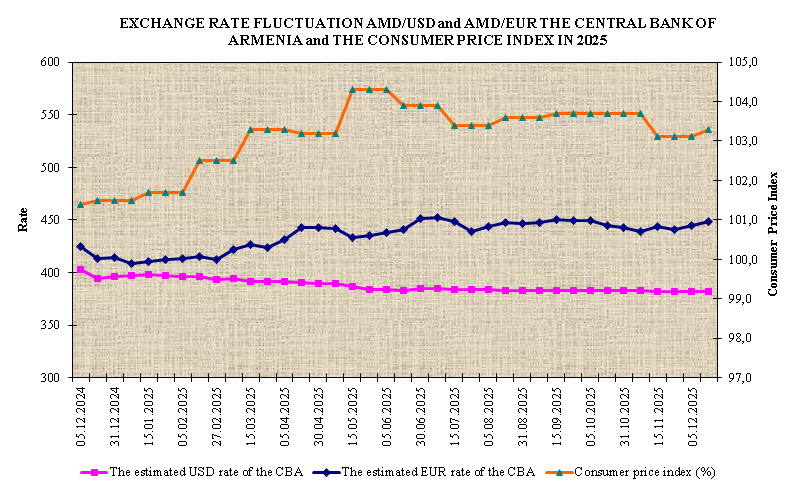
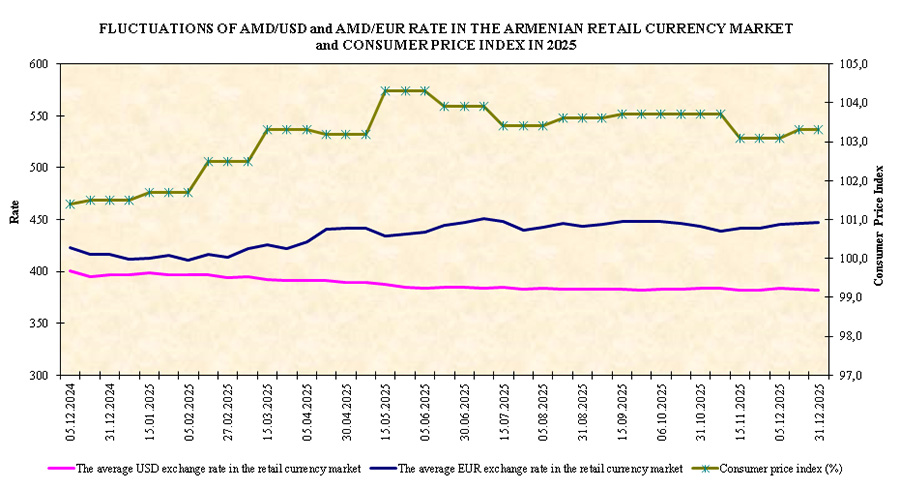
In the first half of 2026, inflation was 3.2% (versus 1.5% the year before), amid rising prices for food by 6%, services by 1.3%, and non-food goods by 0.6%. A year ago, during the same period, food prices increased less noticeably - by 2.2%, services by 1.9%, and non-food goods by 0.8%. June's annual inflation of 5.1% was accompanied by a 4.1% appreciation of the dram against the dollar, which was also observed in less pronounced figures the year before: inflation of 3.9% and a 1% appreciation of the dram against the dollar. Specifically, the dram strengthened in June 2026 to 368.3 drams per dollar from 384.2 drams per dollar in June 2025.
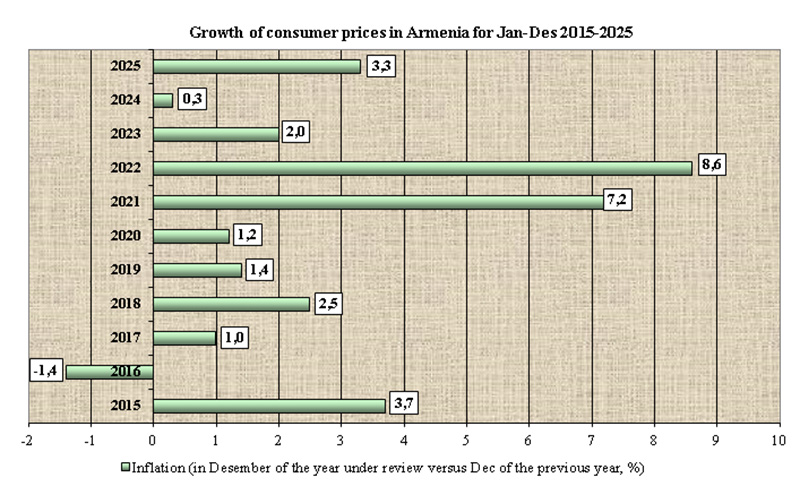
It should be noted that starting from 2025, the inflation target is set at 3% with an acceptable range of +/- 1 percentage point (compared to the previous 4%, +/- 1.5 percentage points).