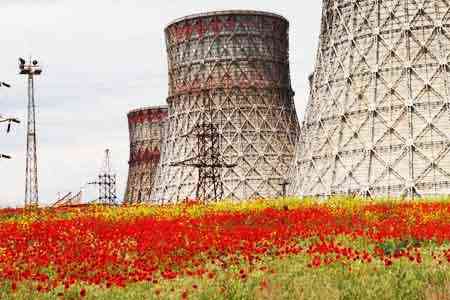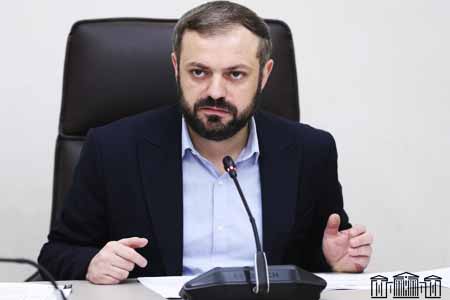



ArmInfo. Armenia is in no rush to decide which country will construct a small modular reactor (SMR) in the country, as the operational lifespan of the existing Armenian Nuclear Power Plant (NPP) can be extended until at least 2036. David Khudatyan, Armenia's Minister of Territorial Administration and Infrastructure, told reporters at parliament on June 11 when asked to clarify whether Armenia had already made a choice in favor of the United States.
The Minister noted that a decision has only been reached regarding the type of reactor. "We have already stated that the plant will be modular. However, we have not yet decided who will build it. Proposals have been received from the United States, France, Russia, South Korea, and China. We are in no hurry to make this decision because our current NPP will remain operational until at least 2036," Khudatyan said.
In this regard, the Minister noted that a program to extend the operation of the Armenian NPP is currently underway. He assured that the Armenian side expects to receive the official extension permit by early August or September. Furthermore, according to Khudatyan, it may be possible to operate the plant even beyond 2036.
"After 2036, we intend to launch a new program to further extend its operation. This is precisely why the Armenian government is not rushing the issue of modular reactors. After all, these are a new type of nuclear power plant. Additionally, it must be taken into account that, as with any new technology, they may initially cost more than they will after a certain period of time," the Minister stated.
Explaining why the country ultimately chose modular reactors, Khudatyan pointed out that they offer greater operational flexibility and allow for smoother integration into the power grid. Addressing critics of the government's decision to move away from constructing a conventional, large-scale NPP, the Minister argued that Armenia has chosen to increase the share of renewable energy sources in its energy mix. "In other words, the emphasis will be placed on building solar power plants as part of our green transition program," Khudatyan concluded.
Recall, the possibility of constructing several small modular nuclear reactors with a capacity of 50-60 MW was previously discussed in Armenia. Moreover, the possibility of constructing them in several regions of the country was even considered. However, one of the most significant challenges in this area is the lack of reactor management skills on the part of Armenian nuclear scientists. Earlier, Gera Sevikyan, Advisor to the Director General of the Armenian Nuclear Power Plant, told ArmInfo that a fundamental decision had been made to build a new unit in the country using the Russian TOI reactor with a capacity of 1,200 MW. However, as RA Minister of Territorial Administration and Infrastructure Gnel Sanosyan subsequently noted, constructing a unit of such capacity is fraught with problems, since the capacity of Armenia's entire energy system remains the same: 1,200 MW. Later, Armenian Prime Minister Nikol Pashinyan announced that the Republic had made a fundamental decision to build a modular nuclear reactor. Moreover, the country of manufacture of the modular nuclear power plant, according to Armenian authorities, will be determined in 2026-2027.