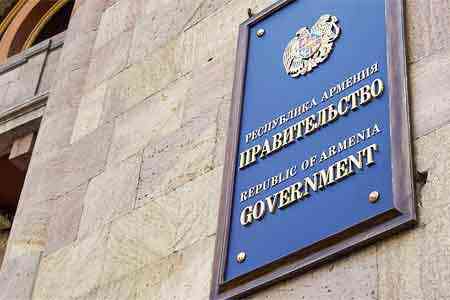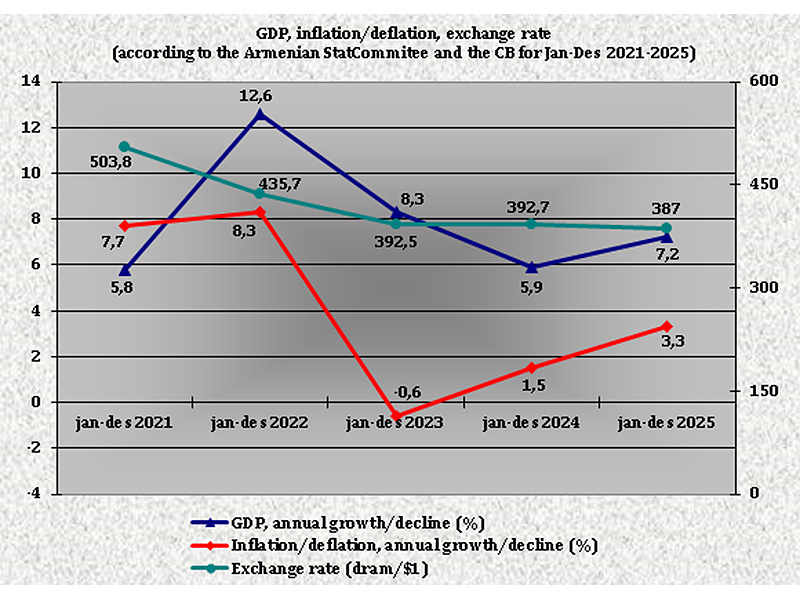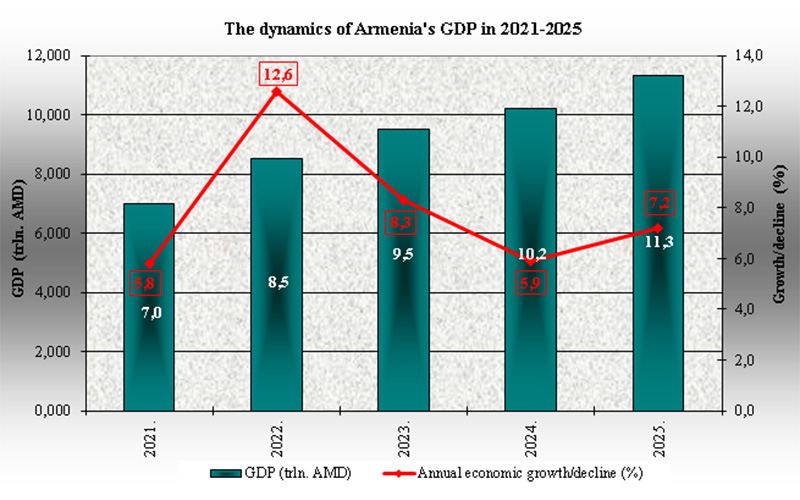



ArmInfo.Real GDP expanded by 7.2 per cent year on year in 2025 in Armenia, with a broad-based expansion led by construction, ICT and financial services, all of which posted double-digit growth, reads the June 2026 report Regional Economic Prospects in the EBRD Regions.
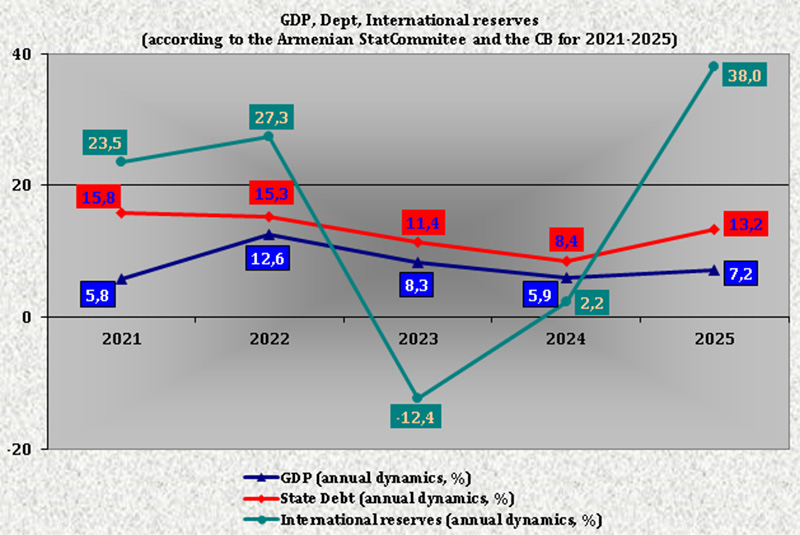
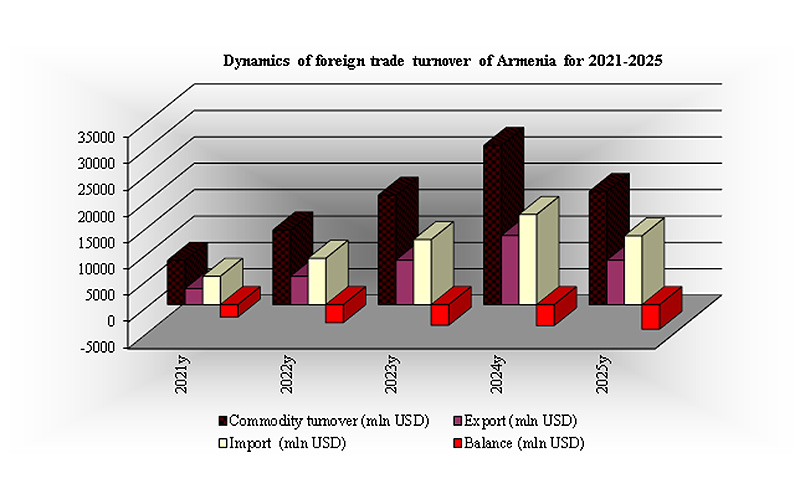
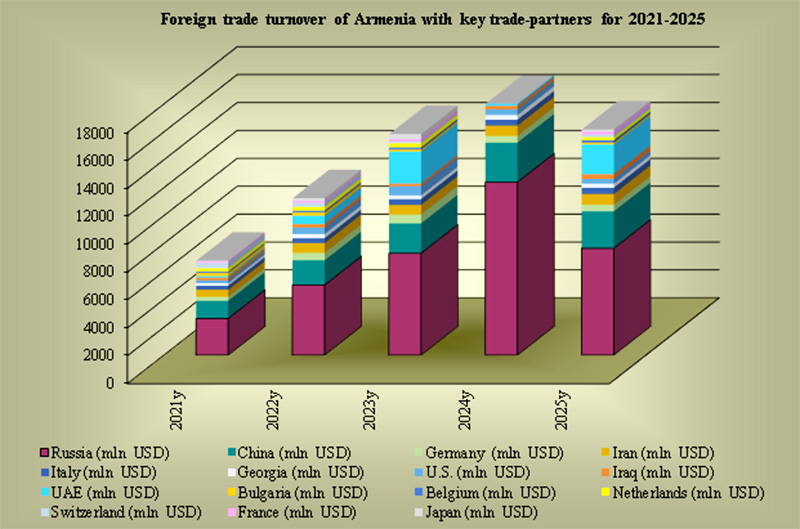
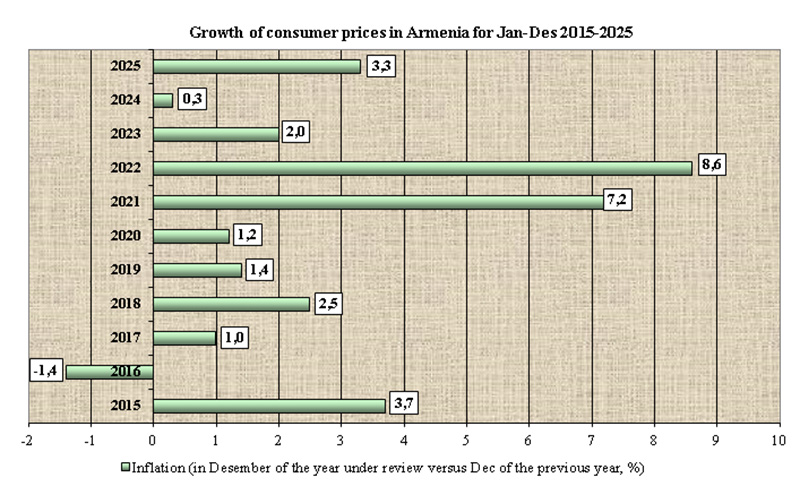
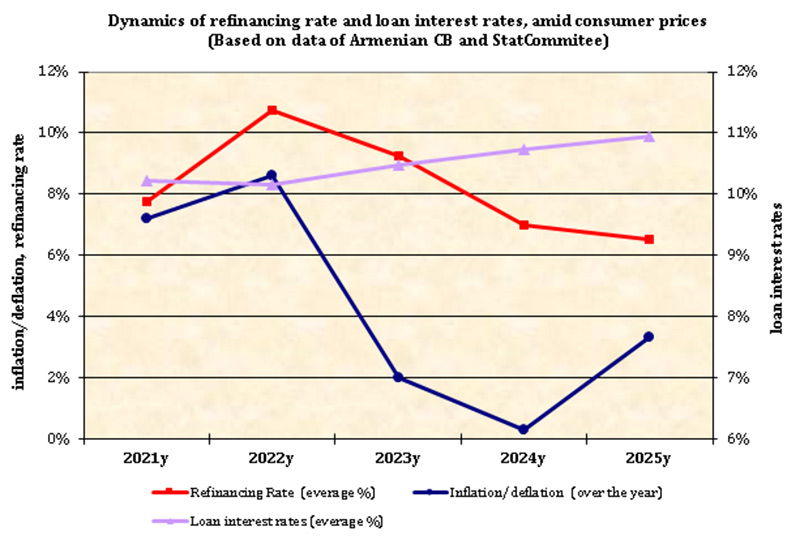
This momentum carried over into 2026, with growth of 7.1 per cent year on year in the first quarter. Headline inflation, which averaged 3.3 per cent in 2025, rose to 5.3 per cent year on year in April 2026, exceeding the central bank's target of 3.0 per cent. The fiscal deficit stood at 3.7 per cent of GDP in 2025, unchanged from 2024, while public debt had stabilised at 49.5 per cent of GDP as at year end. While the current account deficit widened from 4.6 per cent of GDP in 2024 to 7.2 per cent of GDP in 2025 as trade in precious stones and metals declined significantly, the Armenian dram remained broadly stable. Gross international reserves increased to US$ 5.7 billion in April 2026 from US$ 3.9 billion a year earlier, providing four months of import cover. Economic growth is forecast to reach 5.5 per cent in 2026 and 2027. Upside potential stems from a potential border opening with Turkiye, the Regional Economic Prospects in the EBRD Regions June 2026
Trump Route for International Peace and Prosperity (TRIPP), and enhanced cooperation with the EU. In contrast, economic spillovers from the conflict in the Middle East could weigh on the growth outlook by raising the cost of commodity imports, reducing tourism inflows, and complicating trade and logistics.
Azerbaijan
Real GDP growth slowed to 1.4 per cent in 2025 and output contracted by 0.3 per cent year on year in the first quarter of 2026 as oil and gas sector output fell by 1.2 per cent and non-hydrocarbon growth decelerated to 0.2 per cent.
Inflation averaged 5.7 per cent in the first quarter of 2026, near the upper bound of the central bank's target range. The overall fiscal surplus narrowed from 4.1 per cent of GDP in 2024 to an estimated 2.6 per cent in 2025, while public and publicly guaranteed debt remained low, at 28 per cent of GDP at year end. The current account surplus fell from 6.3 per cent in 2024 to 4.6 per cent of GDP in 2025. Against this backdrop, the combined foreign assets of the central bank and the state oil fund (SOFAZ) continued to grow, reaching 112 per cent of GDP in 2025.
Real GDP growth is forecast to pick up to 2.0 per cent in 2026 and 2.5 per cent in 2027 following a weak economic performance at the beginning of 2026. The growth outlook remains sensitive to hydrocarbon prices and production volumes. Increases in global energy prices triggered by the conflict in the Middle East could generate a revenue windfall for Azerbaijan and support growth-enhancing spending and investment, counteracting negative spillovers from the conflict. In addition, regional connectivity and trade initiatives enabled by the US-brokered peace framework with Armenia as well as continued large-scale investment in renewables may boost growth and economic diversification in the medium term.
Georgia
Georgia's real GDP grew by 7.5 per cent in 2025, led by services, as tourism remained an important driver of economic performance. Income from inbound travel was equivalent to 12.3 per cent of GDP in 2025, though growth in the sector was nearly flat in the first quarter of 2026. On the demand side, private consumption was underpinned by solid real wage growth and strong credit expansion, while capital investment contracted for the first time since 2021.
Growth accelerated further to an estimated 9.1 per cent year on year in the first quarter of 2026. Inflation has exceeded the National Bank of Georgia's 3.0 per cent target since March 2025, reaching 5.9 per cent year on year in April 2026. The fiscal deficit narrowed from 2.3 per cent in 2024 to 1.4 per cent of GDP in 2025 on the back of robust revenue growth and under-execution of capital spending.
The public debt-to-GDP ratio fell to 34.4 per cent in 2025, supported by strong nominal GDP growth and a stable exchange rate. The current account deficit declined from 5.3 per cent in 2024 to an historical low of 2.6 per cent of GDP in 2025. Gross international reserves increased to US$ 6.5 billion in April 2026, providing around four months of import cover. Real GDP is forecast to grow by 6.0 per cent in 2026 and 5.0 per cent in 2027. The implementation of flagship investment projects in the real estate, transport and renewables sectors could foster even higher growth.
However, the conflict in the Middle East may damp economic momentum by way of lower tourism revenues and higher costs for imported energy.
Ukraine
Ukraine has preserved macroeconomic stability in the past year thanks to large, frontloaded external financing, despite Russia's war of aggression persisting for a fifth year. Real GDP growth slowed to 1.8 per cent in 2025, as the economy was constrained by labour shortages and frequent disruptions to electricity supply and logistics owing to targeted Russian military attacks.
After declining to 7.4 per cent in January 2026, inflation has been rising again since the start of the Middle East conflict. Higher Regional Economic Prospects in the EBRD Regions June 2026 energy costs threaten to widen the already large external financing gap weighing on economic growth. The fiscal deficit, excluding grants, stood at 23.6 per cent of GDP in 2025 and is projected to remain large in 2026, at 19.3 per cent, reflecting the country's extraordinarily high defence and social spending, financed predominantly by external official support under the recently approved International Monetary Fund (IMF)-supported programme and EU assistance. The IMF-backed programme, which envisages US$ 133.7 billion in official financing for 2026-29, and the unblocking of the EU ?90 billion Ukraine Support Loan, underpin the near-term outlook. Growth is projected at 2.2 per cent in 2026, rising to 4.0 per cent in 2027 if the war can be brought to a halt and if post-war reconstruction begins. A major downside risk comes from the energy crisis caused by the conflict in the Middle East, which could significantly aggravate Ukraine's fragile energy situation.
Belarus
GDP contracted by 0.4 per cent year on year in the first three months of 2026 as manufacturing output declined and agricultural yields remained stagnant. The manufacturing downturn underscores ongoing challenges, including diminished export opportunities to Russia and constrained financing for import substitution. Annual inflation peaked at 7.4 per cent in July 2025, gradually easing to 5.4 per cent in March 2026. Disinflation was largely supported by food price controls. Economic growth is expected to remain sluggish in the short term, reaching 1.1 per cent in 2026 and 1.5 per cent in 2027. Economic sanctions and Belarus's dependence on the Russian economy are significant downside risks.
Russia
Economic growth slowed abruptly, from 4.9 per cent in 2024 to 1.0 per cent in 2025, despite economic activity having been propped up by expansionary war-driven fiscal policy. While manufacturing output continued to increase in the first three months of 2026 on the back of the sustained expansion of the military industrial complex and unemployment reached the low of 2.2 per cent, the overall momentum of the economy has weakened further and GDP declined by 0.2 per cent year on year. Annual inflation subsided to 5.6 per cent in April 2026. In early 2026, oil export earnings fell by 30 per cent from their average 2025 levels, to below US$ 10 billion in February, in part due to tighter enforcement of sanctions. However, the conflict in the Middle East subsequently increased demand for Russian oil, with the average price of a barrel reaching US$ 95 in April 2026. The unexpected windfall gains from oil prices, significantly in excess of the 2026 budget assumptions, are expected to reverse the 25 per cent decline in oil and gas budget revenues recorded in 2025.Real GDP growth is expected to slow to 0.8 per cent in 2026, and remain sluggish, at 1.0 per cent, in 2027. The continued war of aggression against Ukraine, the related economic sanctions and oil price volatility expose the economy to significant downside risks.