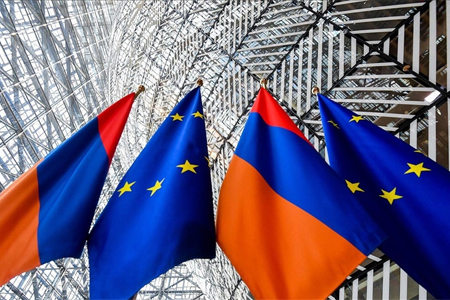


ArmInfo.Further process of drawing closer to the EU threatens Armenia with a complete halt to supplies of gas, oil products, and diamonds from Russia. According to Kommersant, Moscow now considers the duty-free regime for these goods granted in 2013 impossible and is threatening Yerevan with freezing or denunciation of bilateral agreements.
"Russia may suspend or unilaterally denounce the agreement on the supply of natural gas, petroleum products, and rough diamonds to the republic, signed in December 2013, if Yerevan continues its EU accession process. This follows from a letter from Russian Energy Minister Sergei Tsivilev to the Ministry of Territorial Administration and Infrastructure of Armenia," Kommersant (Kommersant) reports.
"Continued practical steps to deepen Armenia's interaction with the European Union and the Armenian government's declared desire to join the EU threaten the preservation and development of the fundamentally high level of Russian-Armenian trade, economic, and investment cooperation, one of the foundations of which are bilateral international treaties," the letter states.
Mr. Tsivilev writes that Armenia's attempts to join the EU "are inconsistent with the nature of the partnership between the governments and economic entities of our countries, built on respect and mutual benefit over decades, and with the practical actions Russia has repeatedly taken to meet Armenia's critical needs on a preferential basis." "Based on this."
The Russian Ministry of Energy and the Armenian Ministry of Territorial Administration and Infrastructure did not provide any comment.
Under the 2013 agreement, Russia permanently abolished export duties on oil products, gas, and diamonds supplied to Armenia.
This marked another step toward the country's accession to the Eurasian Economic Union (EAEU), which currently also includes Russia, Belarus, Kyrgyzstan, and Kazakhstan. Under the agreement, Moscow supplies Yerevan with oil products and gas in the amounts approved by indicative balances for domestic consumption, while re-export to third countries is prohibited. The document also stipulates that if the agreement is terminated by either party, Armenia's obligations to pay compensation to Russia or to recognize unpaid amounts as its sovereign debt to Russia will continue until those obligations are fully fulfilled.
Armenia meets almost all of its gas needs with Russian gas. In 2025, Gazprom supplied the country with approximately 2.7 billion cubic meters of gas. Another 476 million cubic meters comes from Iran under the Gas for Electricity program: Armenia supplies Iran with electricity (primarily generated at the Hrazdan Thermal Power Plant), and Iran supplies Armenia with natural gas at a rate of 3 kWh per cubic meter of gas.
A long-term supply contract for up to 2.5 billion cubic meters has been signed with Gazprom Armenia.
An additional agreement to the 2013 contract, signed in late 2019, set the price of Russian gas for Armenia at $165 per 1,000 cubic meters. The parties agreed to fix the price at this level for another ten years in 2022. Currently, according to Russian President Vladimir Putin, the price is $177 per 1,000 cubic meters. Gazprom announced its intention to spend approximately $400 million on developing the gas transmission system and underground gas storage facilities in Armenia in 2026-2030.
Yerevan annually imports approximately 0.9-1 million tons of petroleum products duty-free from Russia. In 2025, according to preliminary data from the republic's customs service, imports amounted to 890,000 tons (including LPG, bitumen, etc.).
Diamonds were excluded from the agreement's scope in 2016 due to Armenia's accession to the EAEU Treaty. Almost 50% of all stones imported into Armenia are of Russian origin. The country has its own diamond cutting industry, but its volumes are insignificant-200,000 carats per year. There is no domestic mining industry. Armenia primarily re-exports diamonds, including Russian ones.