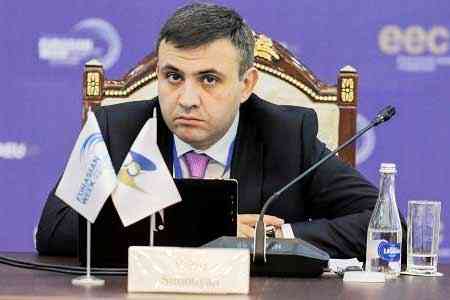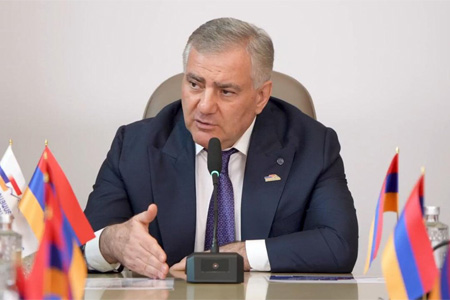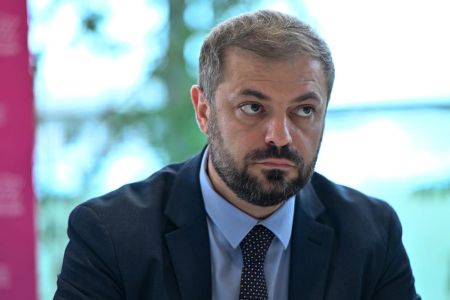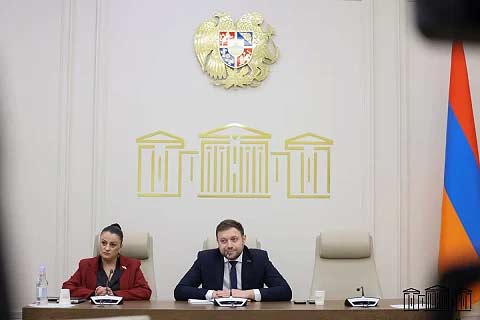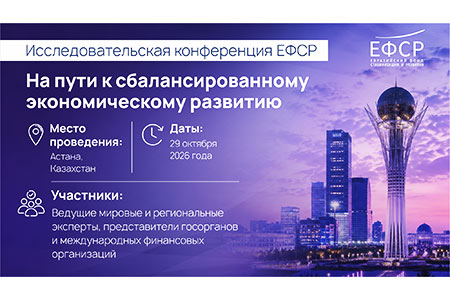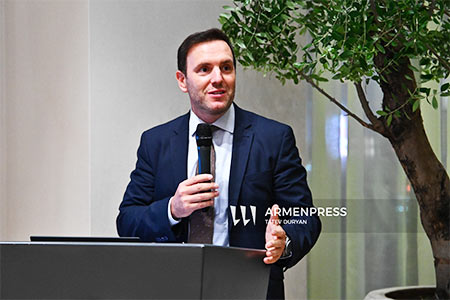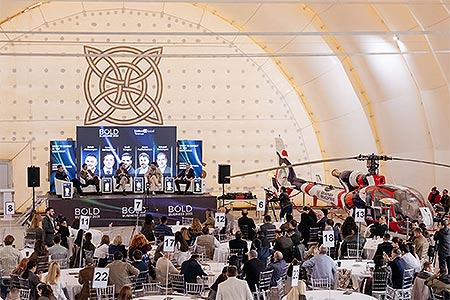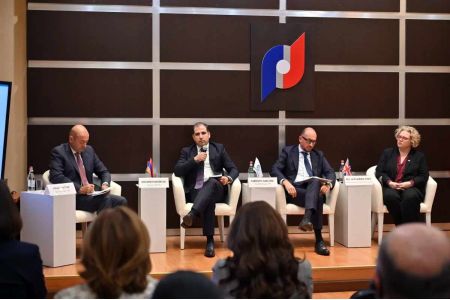


ArmInfo. Preparations for the 5th Eurasian Economic Forum, scheduled to take place on May 28-29 in Astana, are entering the final stretch. The work of the Eurasian Economic Commission's sectoral blocs was discussed at a press conference on May 13 with five EEC ministers, at the Commission's press center.
According to the EEC, Bakhyt Sultanov, Chairman of the EEF-2026 Program Committee and Minister for Economy and Financial Policy of the EEC, emphasized that the Forum's theme is aligned with the priorities of Kazakhstan's presidency of the Eurasian Economic Union, outlined by Kazakh President Kassym-Jomart Tokayev in his address to the heads of state of the EAEU. It reads: "The EAEU in the Global Digital Race: Betting on Artificial Intelligence."
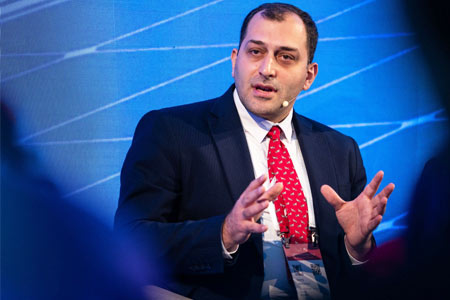
According to Bakhyt Sultanov, his bloc will hold three sessions, one of which will focus on modern solutions in tourism, another on developing the labor market using digital tools, and a third on the experience of international organizations and companies in developing digital transformation in cross- border transportation, which will be held jointly with the Commission's transport bloc. The signing of a Memorandum of Understanding between the EEC and the UN is planned for the latter session. "All organizational mechanisms have been launched, the program has been formulated. We are getting ready for an open, substantive, and engaging dialogue. I invite you to actively cover the Eurasian Economic Forum," Bakhyt Sultanov told the media. As Gohar Barseghyan, Minister of Industry and Agro-Industrial Complex of the EEC, noted, two panel sessions will be devoted to industrial issues. During the first session, participants will consider current issues related to the industrial cooperation mechanism currently in place within the EAEU. The second session examines global trends in the digital transformation of industry, taking into account the experience of the EAEU and UNIDO. "Last year, UNIDO and I signed a joint statement, and now we have a fairly busy bilateral agenda. We plan to sign a joint action plan at the Forum," said Gohar Barseghyan.
The third panel session of this block is scheduled to address the topic of digital modernization of the Union's agricultural market. "We are currently actively working to extend financial support measures to the agro-industrial complex, and I am confident that we will be able to discuss all related issues at the EEF- 2026. I would like to invite all interested parties, especially business representatives, to the discussion," the EEC Minister concluded.
EEC Minister for Technical Regulation Alexander Subbotin announced that his block will organize two sessions. The main idea of the discussion on the digital ecosystem of product safety is to address how digital technologies and artificial intelligence can be applied in technical regulation within the EAEU. "It's important that representatives of national standardization bodies, government agencies, and international organizations will participate in the session. This will allow us to discuss the topic not just theoretically, but from various practical perspectives as well," emphasized Alexander Subbotin.
The panel session, "Digitalization and Artificial Intelligence in SPS Measures Innovative Solutions," will discuss, among other things, the prospects for using digital technologies and artificial intelligence to ensure the sanitary and epidemiological well-being of the population, as well as veterinary and quarantine phytosanitary security within the EAEU. Speaking about the events of his section at the Forum, Arzybek Kozhoshev, Minister of Energy and Infrastructure of the Eurasian Economic Commission (EEC), noted: "In a context of geopolitical turbulence, the importance of Eurasian routes rail, road, and air is increasing every day. The most important goal is to reduce delivery times and costs for transport companies."
In terms of transport and infrastructure, Arzybek Kozhoshev identified the three "C's" delivery time, cost, and stability. These issues will be discussed with businesses at panel sessions. Furthermore, representatives from several international organizations will share their experiences in reducing costs, improving safety, and discuss the impact of digital technologies on goods transportation. According to the EEC Minister, this will provide a reliable foundation for the development of joint projects between the Commission and the business communities of the Union countries.
Four sessions are planned under the auspices of EEC Trade Minister Andrey Slepnev, including "Eurasian Trade and Logistics." The EEC Minister emphasized its significance first and foremost. "Today, international trade flows are undergoing significant changes, due to the growing role of intracontinental trade routes and regionalization. And within the EAEU, these two trends are naturally converging. Therefore, we will discuss the potential impacts of the intersection of Eurasian transport corridors and the extensive network of trade agreements that our Union is building," said Andrey Slepnev. The climate agenda remains a key focus, with decisions being made by the European Union and China making carbon footprint calculations, unified methodologies, and the prevention of barriers even more pressing.
Two practical digital sessions will be dedicated specifically to the Forum's theme. One session titled "Digital Trade in the EAEU," aims to scale up national solutions in electronic document management, smart contracts, and artificial intelligence within the Union. The other session, "Digital Labeling," Two practical digital sessions will be dedicated specifically to the Forum's theme. The first session aims to scale up national solutions in the areas of electronic document management, smart contracts, and artificial intelligence within the Union. The other one will explore how labeling is evolving beyond a simple traceability tool to also serve as a method for monitoring the legality of goods circulation.
The organizers have sent out over two thousand invitations to potential Forum participants. Guests at the panel sessions will include heads of industry ministries from Union member states and observer states, as well as over 70 delegates from third countries, including the United States, China, Azerbaijan, Vietnam, Egypt, Mongolia, Turkmenistan, Tajikistan, and several others.
The Forum will also feature the heads of UN agencies (UNCTAD, UNIDO, UNECE, UNESCAP, UNCITRAL), leading international organizations such as the WTO, WHO, OECD, and others. Major regional associations ASEAN, BRICS, the SCO, and the CIS will participate in the Forum. Twelve important integration documents are being prepared for signing on the sidelines of the Forum: memoranda, agreements, protocols, and plans for joint activities.