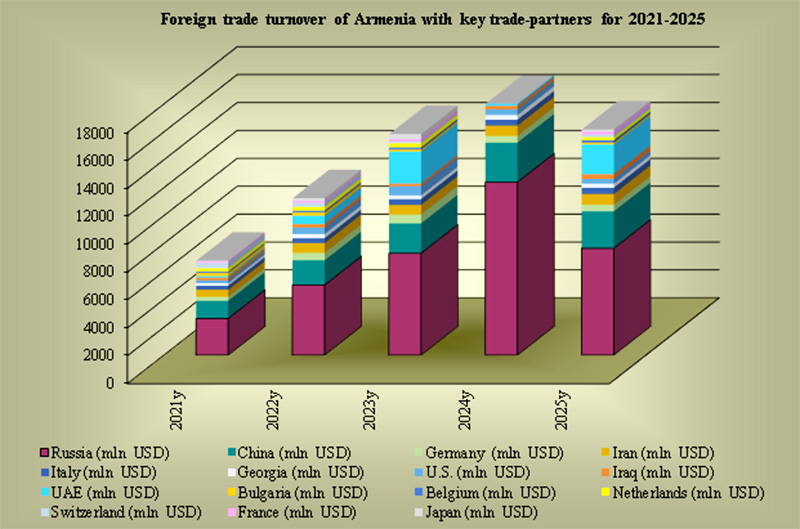


ArmInfo. The share of Armenia's top five trading partners-Russia, China, Iran, the UAE, and Germany-decreased in Q1 2026 to a combined 53.2% of total turnover (from 64.5% or $2.9 billion in Q1 2025), amounting to $2.5 billion in absolute terms. Two of them, Russia and the UAE, continued to decline by 17.2% and 63.1%, respectively, slowing from last year's 63.8% and 78.8%.
Meanwhile, foreign trade volumes with China and Germany grew by 19.6% and 38.1% (from a decline of 33.3% and 7% a year ago), while growth with Iran slowed significantly from 15.2% to 1.9%. This is evidenced by data from the Statistical Committee of the Republic of Armenia. Armenia's foreign trade with the EAEU fell by 15.6% annually in the first quarter of 2026 (versus a 63% decline a year ago) to $1.4 billion, while with the EU it sharply accelerated in growth to 54.3% (from 0.1% a year ago), exceeding $763.2 million. Moreover, among the EAEU countries, a decline in volumes was recorded only for the Russian Federation, while most EU countries preferred to increase volumes - these are Germany, Bulgaria, Italy, France, Belgium, Poland, the Netherlands, Romania, Spain, Slovakia, Austria, Denmark, Lithuania, the Czech Republic, Cyprus and Portugal, and many of them significantly.
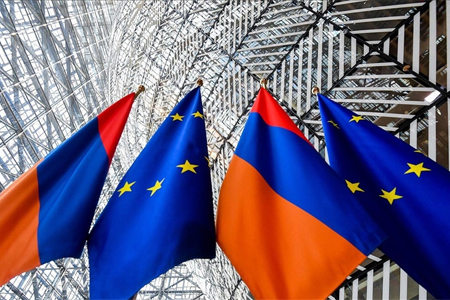
This change in annual dynamics reduced the share of the EAEU in the structure of Armenia's foreign trade from 37.1% to 30% (due to the Russian Federation - from 35.7% to 28.3%), while the EU's share, on the contrary, increased from 11% to 16.2%. In particular, in exports, the share of the EAEU decreased from 43.6% to 39% (due to the Russian Federation - 40.9% to 36.3%), while the EU's share increased from 7.8% to 14.1%. In imports, the picture is similar: the share of the EAEU decreased from 33.2% to 24.5% (due to the Russian Federation - 32.6% to 23.4%), while the EU's share increased from 12.9% to 17.5%. The share of the remaining countries representing the leading five changed as follows: China increased its share in exports from 6.4% to 14.3% and decreased its share in imports from 17% to 15.3%; the UAE significantly reduced its share in exports from 24.9% to 8.3% and further reduced its negligible share in imports from 0.6% to 0.5%; Germany increased its share in exports from 1.4% to 1.6% and in imports from 2.7% to 3.7%; Bulgaria increased its share in exports more significantly from 1.3% to 5.2% than in imports - from 0.3% to 0.7%; the USA continues to increase its share in imports more noticeably from 2.8% to 3.3% than in exports from 0.5% to 0.6%. Iraq reduced its share of exports from 4.6% to 4.4%, while accounting for a meager 0.03% of imports. Iran maintained its share of imports at 5.3%, reducing its share from 1.4% to 1%. The top five exporters are Russia, China, the UAE, Bulgaria, and Iraq, with a combined volume of $1.2 billion. The top five importers are Russia, China, Iran, Germany, and the United States, with a combined volume of $1.5 billion. Both exports and imports are declining for Russia and the UAE. For China, significant export growth has been accompanied by a decline in imports. For Germany, double-digit export growth has slowed somewhat, while imports have recovered from recession to high growth. For the United States, both exports and imports have recovered from recession to double-digit growth. For Bulgaria, export and import growth have accelerated sharply, jumping several-fold. Toward Iraq, the emerging decline in exports is accompanied by a more rapid, several-fold increase in imports. Toward Iran, the decline in exports is accelerating, while import growth is slowing.
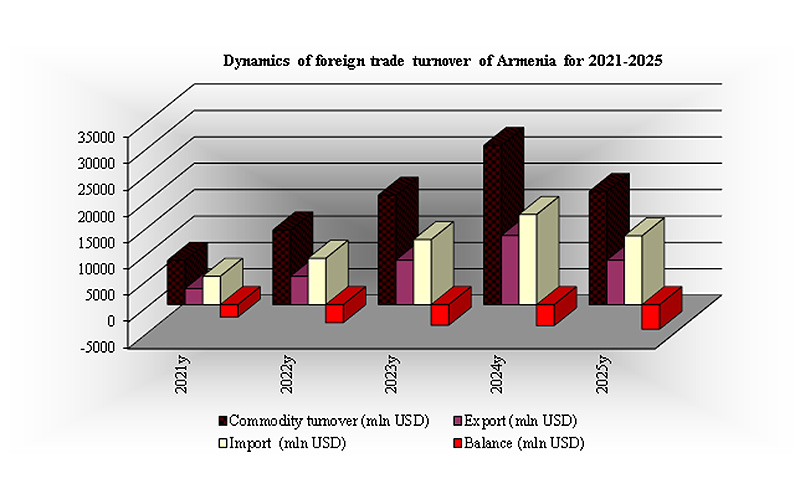
Armenia's foreign trade turnover in the first quarter of 2026 totaled $4.7 billion, an increase of 4.6% year- on-year (compared to a 54.2% decline a year ago). In particular, improved dynamics were noted for both exports and imports, reaching 4.5-4.6% growth (compared to a 61.8-47.9% decline a year ago), with volumes of $1.8 billion and $2.9 billion, respectively.
Armenia's negative foreign trade balance in the first quarter of 2026 increased by 5% year-on-year to $1.2 billion, of which the negative $265.8 million and $199.1 million were with the EU and China, respectively, with the former growing by 14.3% and the latter declining by 46.5%. The negative balance of foreign trade with the United States increased by 27% to $87.7 million, while the negative balance in the direction of Iran was more significant - $139 million with an annual increase of 13%. Armenia's trade deficit with Russia decreased fivefold to $51 million, while the negative balance with the EAEU countries narrowed by the same amount to $36.8 million. The positive trade balance with the UAE also decreased significantly, threefold to $130.2 million. Notably, the positive trade balance with Bulgaria increased significantly, more than fivefold to $70.2 million, with Belgium by 3.4 times to $27.1 million, with Lithuania by 3.2 times to $2.7 million, and with Switzerland by almost two times to $53.7 million. The positive balance with the Netherlands also decreased by 2.3 times to $3.7 million, and with Iraq by 1.4% to $76.6 million.
It should be noted that according to the updated data from March of this year, According to the Central Bank of Armenia's forecast, after nearly equal growth in exports and imports in 2024 of 30.9-32.7% and a decline in 2025 of 30.5% (for exports) and 23.7% (for imports), the dynamics will improve in 2026, with growth in both exports to 25.5-28.5% and imports to 36.7-34.9%. The Central Bank expects the growth trend to continue in 2027, but the rate will slow to 16-19% for exports and 11-14.3% for imports. The International Monetary Fund, in its December forecast, also expecting Armenia's foreign trade to turn from recession to growth in 2026, outlined overly modest rates of export and import - 2.2-2.1%, with a further moderate acceleration in 2027 to 3.4-3.7%.