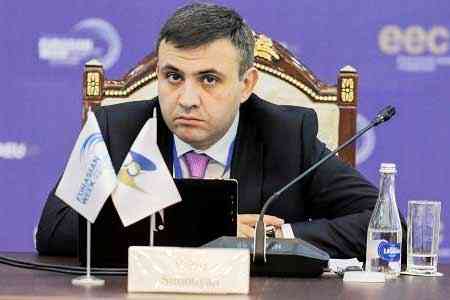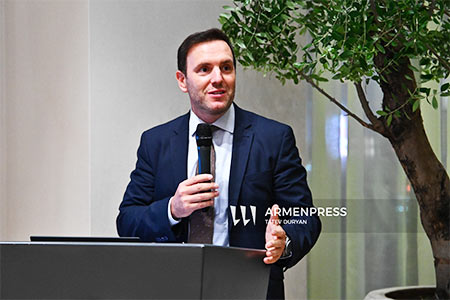



ArmInfo. Armenia's industry is showing clear signs of stabilization, recovery, and sustainable growth. Edgar Zakaryan, Deputy Minister of Economy of Armenia, expressed this opinion on his Facebook page.
He noted that after 1991, Armenia's industrial sector experienced a deep recession and systemic degradation for nearly three decades.
According to the Deputy Minister, starting in 2018, the government has gradually begun implementing a policy of industrial recovery, or more precisely, an industrial revival policy. "While up until 2025, and even throughout 2025 itself, the industry continued to develop amidst high levels of external market instability, fluctuations in global metal prices, and global economic uncertainty, a significant stabilization of industrial activity has already been recorded in the first months of this year.
It is particularly important that the manufacturing industry-the economic sector that generates high added value, export potential, and technological development-remains the main driver of growth," Zakaryan noted.
In recent months, he noted, positive dynamics have been observed in the food industry, certain areas of metallurgy, and a number of manufacturing subsectors.
In this vein, Zakaryan noted that in recent years, the government's economic policy has been purposefully focused on restoring and strengthening the manufacturing economy. "As a result, even amid external risks, Armenia continues to maintain macroeconomic stability and the potential for industrial recovery," the deputy head of the department emphasized.
At the same time, Zakaryan emphasized the need to realistically assess the existing challenges. Among the latter, he cited instability in foreign markets, geopolitical processes, and changes in the global economy. "However, the difference is that today Armenia faces these risks with a more competitive economy, a more organized public administration system, and a higher level of institutional resilience.
Our goal is not simply to ensure high economic growth.
Our strategic objective is to build a productive, export-oriented, and technologically advanced Armenia, where industry will become not only the driving force of the economy but also one of the most important pillars of national economic sovereignty," he concluded.
It is worth noting that, according to the Statistical Committee of the Republic of Armenia, Armenia's industrial sector grew by 13.4% in the first quarter of 2026 (from an 18.5% decline in the same period of 2025), reaching 748 billion drams ($1.9 billion).
The manufacturing industry also reversed its annual dynamics from a 26% decline to a 9.5% growth, with a volume of 458.4 billion drams.