

ArmInfo. The International Monetary Fund (IMF) forecasts 5.3% GDP growth for Armenia in 2026 (compared to 7.2% in 2025), with an acceleration to 5.5% in 2027, as noted in the IMF's April report, "World Economic Outlook: Global Economy in the Shadow of War."
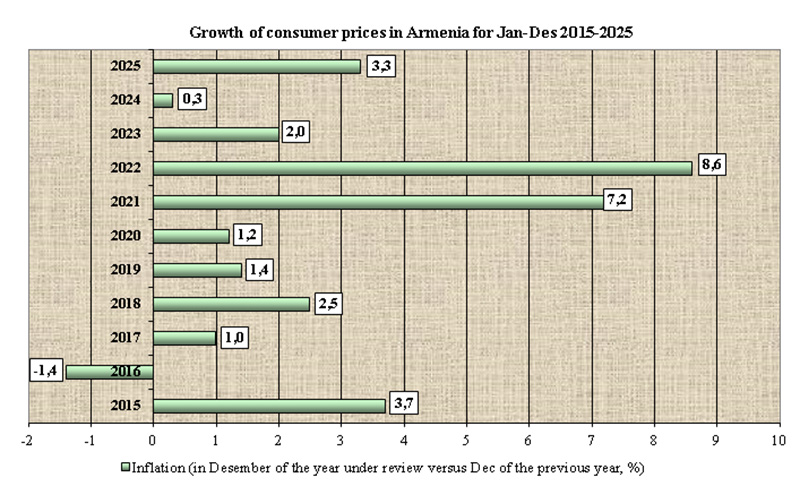
The IMF expects Armenia's inflation to accelerate to 3.6% in 2026 (from 3.3% in 2025), but then to fall to 3.4% in 2027 (compared to the target of 3%, +/- 1 percentage point).
The IMF forecasts Armenia's unemployment rate to continue to decline from 13% in 2025 to 12.8% in 2026 and to 12.7% in 2027.
The IMF expects the current account deficit to GDP to decline from 6.7% in 2025 to 6% in 2026 and then to continue to decline to 5.2% in 2027. For Armenia's neighboring countries, the IMF forecasts for 2026- 2027 are as follows: in Georgia, GDP growth is 5.3-5% (versus 7.5% in 2025), inflation is 4.4-3% (compared to 3.9% in 2025), unemployment is 13.9% (unchanged), and the current account deficit to GDP ratio is expected to increase to 5-4.5% (from 2.6% in 2025); In Azerbaijan - GDP growth of 2.2-2.5% (compared to 1.4% in 2025), inflation of 6-5.1% (compared to 5.6% in 2025), unemployment of 5.3-5.2% (compared to 5.3% in 2025) and an increase in the current account surplus to GDP ratio to 9.7-5.4% (from 5.5% in 2025); in Turkey - GDP growth of 3.4-3.5% (compared to 3.6% in 2025), a decrease in inflation to 28.6-21.4% (from 34.9% in 2025), unemployment of 8.3-8.7% (compared to 8.3% in 2025) and an increase in the current account deficit to GDP ratio to 2.8-2.5% (from 1.9% in 2025). In Iran, according to the IMF forecast, the economic decline will accelerate in 2026 to 6.1% (from 1.5% in 2025), after which growth of 3.2% will be outlined in 2027, inflation, already high, will advance from 50.9% in 2025 to 68.9% in 2026, after which it will decrease in 2027 to 39.6%, the unemployment rate will increase to 9.2-9% (from 8% in 2025), and the current account surplus of 0.6% of GDP recorded in 2025 will fall in 2026 to a deficit of 1.8%, which will decrease to 0.2% in 2027.
In Russia, the IMF forecasts very low GDP growth of 1.1-1% for 2026-2027 (compared to 1% in 2025), a decrease in inflation to 5.6-4.3% (from 8.7% in 2025), an increase in the unemployment rate to 2.4-2.6% (from 2.2% in 2025), and an increase in the current account surplus to 2.9-2.3% of GDP (from 1.6% in 2025). In Belarus, the IMF forecasts similar GDP growth of 1.2-1% for 2026-2027 (compared to 1.3% in 2025), a decline in inflation to 6.4-6.2% (from 6.6% in 2025), unemployment remaining at 2.9%, and an increase in the current account deficit to 2.7-3.4% of GDP (from 2.6% in 2025). Meanwhile, in Ukraine, where the war has been going on for five years (since February 24, 2022), the IMF predicts a more noticeable GDP growth in 2026-2027 of 2-3.5% (compared to 1.8% in 2025), a decrease in inflation to 6.1- 7.7% (from a double-digit 12.7% in 2025), a decrease in the unemployment rate from 11.6% in 2025 to 10.2% in 2026, but then an increase to 12%, as well as an increase in the current account deficit in 2026 to 18.9% of GDP (from 15% in 2025) with a subsequent decrease in 2027 to 16.6% of GDP. In total, for the Caucasus and Central Asia region, the IMF forecasts a slowdown in economic growth in 2026-2027 to 4.8- 4.5% (from 6.2% in 2025), a decrease in inflation to 8-7.2% (from 8.4% in 2025), and a decrease in the current account deficit in 2027 to 1.6% of GDP (from 2.2% in 2025).
In the US, according to the IMF forecast for 2026-2027, economic growth will change imperceptibly to 2.3-2.1% (compared to 2.1% in 2025), inflation will initially rise to 3.2% (from 2.7% in 2025), but then go down to 2.1%, the unemployment rate, after rising to 4.4% (from 4.3% in 2025), will decrease to 4.2%, and the current account deficit will remain almost unchanged - 3.7-3.6% of GDP (compared to 3.6% in 2025). In Europe, the IMF forecasts a slight change in economic growth for 2026-2027 to 1.4-1.6% (from 1.6% in 2025), a decrease in inflation to 5.4-4.3% (from 6.2% in 2025), and a decrease in the current account surplus to 1.3-1.4% of GDP (from 1.6% in 2025), while the unemployment rate in the eurozone will decrease to 6.2-6.1% (from 6.3% in 2025). In China, according to the IMF forecast for 2026-2027, GDP growth will slow to 4.4-4% (from 5% in 2025), inflation will accelerate to 1.2-1.5% (from zero in 2025), the unemployment rate will remain at 5.1%, and the current account surplus will decrease to 3.5-3.3% of GDP (from 3.7% in 2025).
Global Economy Tested Again
In its report, the IMF notes: "The global economy has, to date, withstood a series of shocks, yet another one-this time a military conflict engulfing the Middle East since the end of February-is testing this resilience. This is the latest culmination in a series of events that have been reshaping international relations and raising geopolitical tensions markedly across all regions in recent years (Figure 1.1). The conflict has already inflicted humanitarian costs, damaged critical infrastructure, and severely disrupted maritime and air traffic in the affected region. Economies around the world face repercussions through the direct impact of higher commodity prices, indirect secondorder effects on inflation expectations-which tend to be especially sensitive to energy and food prices-and amplification effects coming from riskoff sentiment in financial markets. Commodityimporting emerging market and developing economies are at risk of being hit harder, with a depreciation of their currencies exacerbating the impact of higher energy and food prices. The global economic impact will crucially depend on the conflict's duration, intensity, and scope, which are inherently unpredictable.
This latest shock comes less than a year since the shift in US trade policies, and the transition to a new international trade system is still ongoing. Following recent court rulings and executive actions, the overall US effective statutory tariff rate is about 5.3 percentage points below the level assumed in the October 2025 World Economic Outlook (WEO) (Figure 1.2), and changes in the cases of a few countries are more substantial. The current environment has incentivized a growing number of countries to finalize long- standing trade negotiations or start new partnerships to foster economic ties among themselves, such as the one between the European Union (EU) and MERCOSUR (the Southern Common Market). Amid these developments, uncertainty, although lower than the peaks it reached in 2025, is still historically high Several inflection points in the coming months may trigger spikes."
The IMF expects monetary policy differentiation across major jurisdictions to persist: In the US, a gradual reduction in the key interest rate is projected, approaching 3.1% by the end of 2027; in the Eurozone, a 50 basis point increase in the key interest rate is expected during 2026.
The IMF notes that the forecasts take into account the impact of the war in Iran, assuming the conflict will continue for several more weeks, followed by a gradual recovery, with disruptions fading and production and exports from the region returning to normal by mid-2026. Fiscal and trade policies are assumed to remain unchanged in their current form throughout the forecast period. However, uncertainty surrounding trade and other economic policies, as well as geopolitical developments, will remain elevated until the end of 2027.
It should be noted that the Central Bank of Armenia in its March forecast predicted GDP growth of 7.1- 4.7% for 2026 and then 5.7-5.3% in 2027. Fitch Ratings in its forecast updated in January,2026 expects stable prospects for economic growth in Armenia - above 5% in 2026-2027. S&P Global Ratings in its forecast updated in February of this year announced a slowdown in GDP growth in Armenia in 2026 to 5.3% and then to 4.8% in 2027, after which the rate will slightly accelerate to 5% in 2028. In April, 2026, the Asian Development Bank forecast GDP growth of 5.5% for Armenia in 2026, with an acceleration to 5.7% in 202. Armenia's draft state budget for 2026 projects GDP growth of 5.4%.
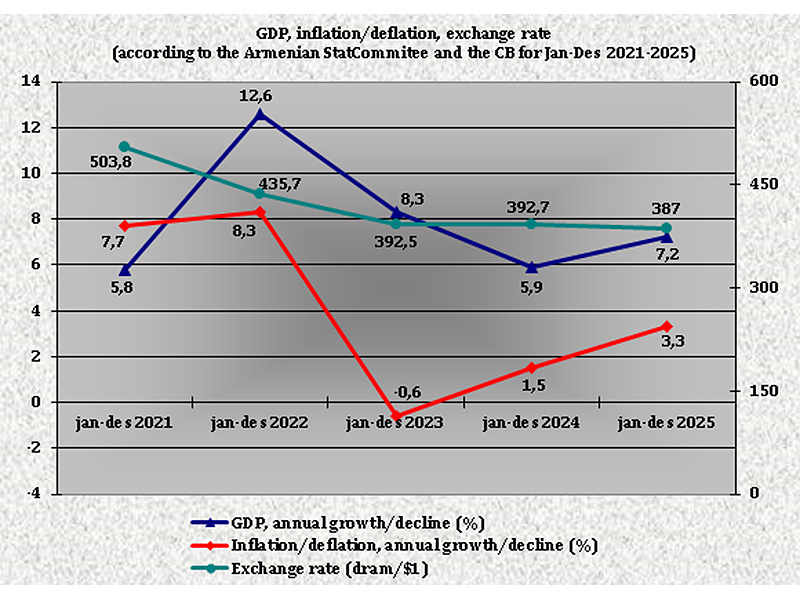
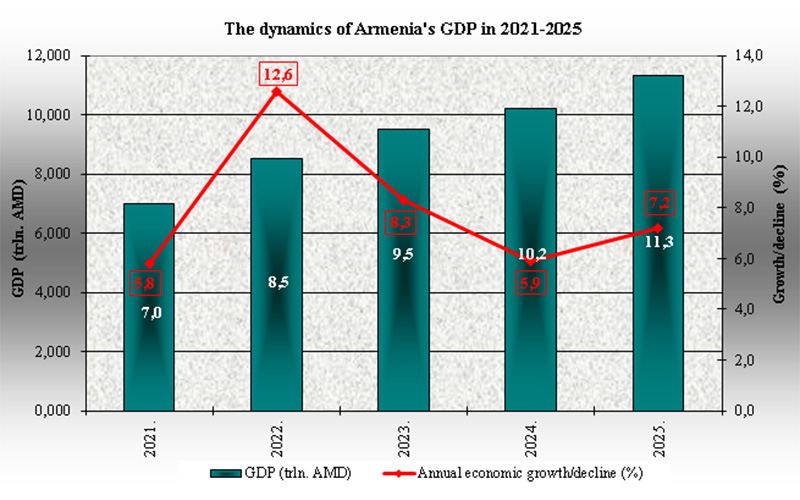
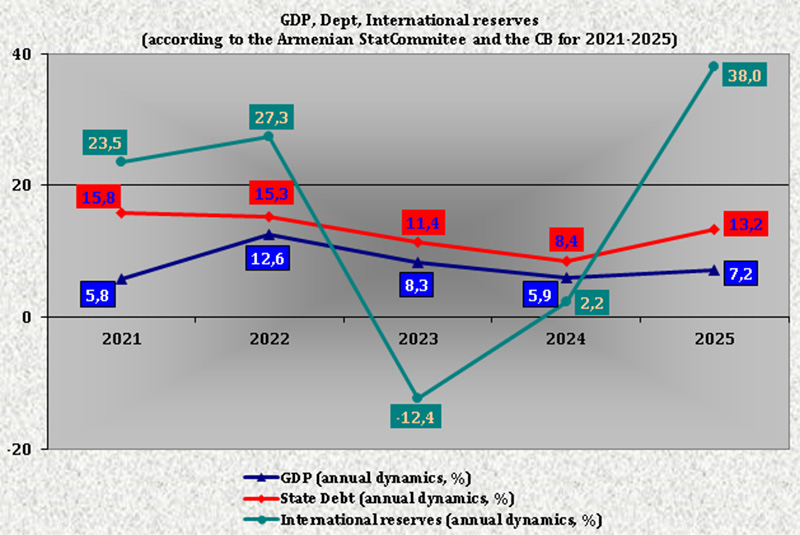
According to the RA Statistical Committee, Armenia's GDP growth, after accelerating from 5.8% to 12.6% in 2022, slowed to 8.3% in 2023 and then to 5.9% in 2024. The rate then accelerated to 7.2% in 2025, reaching 11.318 trillion drams (over $29.2 billion) in absolute terms. The GDP deflator index also increased from 106.9% to 108% in 2022, fell to 103.1% in 2023 and to 101.4% in 2024. However, it rose to 103.6% in 2025.