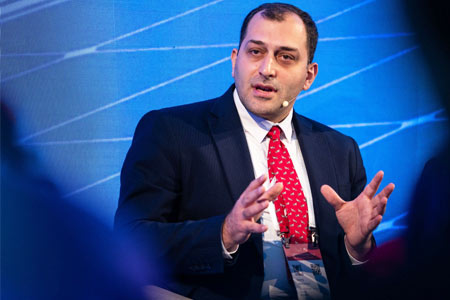



ArmInfo. The Central Bank of Armenia is preparing a package of legislative initiatives aimed at improving risk management. This was announced by Central Bank Chairman Martin Galstyan at a meeting of the National Assembly Committee on Financial, Credit, and Budgetary Affairs on April 6.
He noted that currently, the Central Bank is often forced to react post-factum to violations committed by a commercial bank, recommending correction. However, given its limited oversight capabilities, the Central Bank proposes focusing on risks that have the greatest impact on financial stability. In this regard, it is planned to establish a scale of highest (banking institutions) and lowest (currency exchange offices) risks.
The Central Bank's resources will be divided proportionally between these institutions, with the majority of resources focused on those risks that are more systemically important.
Another change concerns the Central Bank's preventative measures. In addition to the reporting requirements, the country's commercial banks will also be required to implement the SREPP system, which ensures secure funds transfers and financial messaging, overseen by the Central Bank. Preventative measures will be assessed based on the bank's business model, the quality of its management, and all risks, including market and liquidity risks, among others. For each of these, the commercial bank will receive an assessment. Based on this assessment, the Central Bank will be able to require the bank to accumulate additional capital to counter any potential future challenges before committing violations.
The head of the Central Bank emphasized that his agency will pay special attention to innovative projects aimed at ensuring financial stability over the next six years. In particular, legislative amendments are planned to regulate issues related to competition in the banking sector. Previously, it was believed that a larger number of banks, currently 27, would ensure this competition, but experience has proven this untrue.
Now, plans are underway to introduce a so-called Lego license. In other words, if a financial institution is found that wishes to provide financial services with a small stake and a small amount of capital, but is still able to compete with dominant players, they will be granted this opportunity. To this end, plans are underway to create an Investment or Digital Bank, which would be able to provide additional capital to these smaller players. Currently, as Galstyan noted, preliminary discussions are underway on this issue. The head of the Central Bank is confident that the introduction of these new instruments will radically change the market situation.