

ArmInfo. Armenia favors access to modern technologies, and in this regard, the agreements reached with the United States will enable the country to gain full information on the small modular reactor (SMR) technology possessed by the United States.
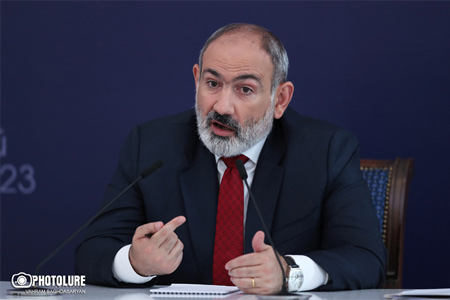
Armenian Prime Minister Nikol Pashinyan made this statement to reporters on February 13, referring to the completion of negotiations between Armenia and the United States on the "123" agreement in civil nuclear energy.
According to Pashinyan, information on such technologies is not available to all countries. "I would like to point out that for countries not included in this agreement, these technologies remain unknown. Our relations with America are developing, and we have signed two or three agreements that will allow the United States to present us with additional details of this technology," the Prime Minister noted. Pashinyan acknowledged that they had the opportunity to discuss this issue with their Russian colleagues. However, that similar technology is used in Russia (on water), specifically in Chukotka, and not on land. "We have asked our Russian colleagues to arrange a visit for an Armenian delegation to access to this technology. The key point is that Russia does not have a land-based facility. Significant progress has been made in Korea and China in this regard. The agreement was signed so that we could obtain more detailed information on this topic. We intend to acquire it not only from the US, but from anyone who possesses it," Pashinyan concluded.
Recall, on February 9, following talks with Armenian Prime Minister Nikol Pashinyan in Yerevan, US Vice President J.D. Vance announced at a press conference that Armenia and the US had completed negotiations on the "123" agreement in civil nuclear energy, with investments of approximately $9 billion expected. He explained that the initial investment would be $5 billion, with a further $4 billion expected in the second phase.
It should be added that the possibility of constructing several small modular nuclear reactors with a capacity of 50-60 MW had previously been discussed in Armenia. Moreover, the possibility of constructing them in several regions of the country was even considered. However, one of the most significant challenges in this area is the lack of experience in operating these reactors among Armenian nuclear scientists.
Earlier, Gera Sevikyan, Advisor to the Director General of the Armenian Nuclear Power Plant, told ArmInfo that a fundamental decision had been made to construct a new unit in the country using the Russian TOI reactor with a capacity of 1200 MW. However, as RA Minister of Territorial Administration and Infrastructure Gnel Sanosyan later noted, constructing a unit of such capacity is fraught with problems, as the capacity of Armenia's entire energy system remains at 1,200 MW. Later, Armenian Prime Minister Nikol Pashinyan announced that they had made a fundamental decision to build a modular nuclear reactor. The country of manufacture for the modular nuclear power plant, according to Armenian authorities, will be determined in 2026-2027.
However, it should be noted that Pashinyan did not mention in his comments that the state corporation Rosatom is already implementing Russia's first land-based small nuclear power plant (ASMP) project in Yakutia, using RITM-200N reactors. The plant is being constructed in the village of Ust-Kuyga in the Ust- Yansky District, and its total capacity will be 110 MW (two 55 MW units). Commissioning is scheduled for 2031. This is a key project for providing energy to industrial clusters in the Arctic.