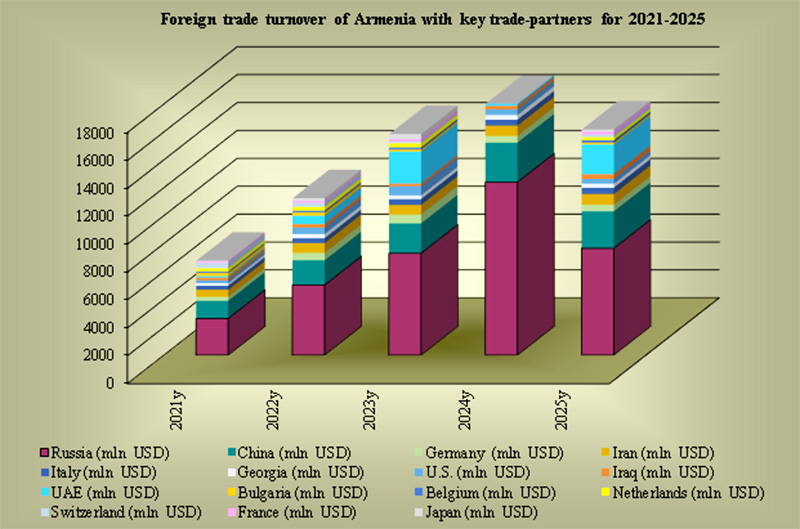



ArmInfo. The TOP-5 countries in foreign trade with Armenia are Russia, China, the UAE, Iran and Germany, with a total volume for January-July 2025 of $7.4 billion (65% of the total turnover). Of these, four have reduced their volumes year-on-year: Russia by 52.1%, China by 12.5%, the UAE by 67.9%, Germany by 4.2%, despite the fact that a year ago the Russian Federation, the UAE and China demonstrated significant growth, while Germany was then in a more pronounced decline. At the same time, Iran managed to improve the annual dynamics, exiting a 2% decline by 6.3% growth. Judging by the data of the Statistical Committee of the Republic of Armenia, a significant drop in the volume of foreign trade between the Russian Federation and the UAE with Armenia is due to the elimination of the factor of re-export and re-import of diamonds and gold.
In total, Armenia's foreign trade with the EAEU fell by 51% in January-July 2025 compared to the same period in 2024 (against a 2.3-fold increase a year ago) to $4.1 billion, and with the EU it grew by 9.6% (from a 21.4% decline a year ago) to $1.4 billion. Moreover, among the EAEU countries, a significant drop in volumes was recorded for the Russian Federation, while half of the EU countries preferred to increase volumes - these are the Netherlands, France, Romania, Austria, Spain, Slovakia, Finland, Italy, Poland, Hungary, Sweden. Such a change in annual dynamics reduced the share of the EAEU in the structure of Armenia's foreign trade from 43.1% to 36.4% (due to the Russian Federation - from 42.3% to 34.9%), and the share of the EU, on the contrary, increased from 6.5% to 12.2%.
The leading five trading partners of Armenia - Russia, China, the UAE, Iran and Germany - provided the volume of foreign trade for January-July 2025 at the level of $3.98 billion, $1.4 billion, $1.3 billion, $413.3 million and $260.1 million, respectively. In particular, in the direction of Russia, the dynamics of imports worsened from a growth of several times to a significant 63.9% decline (to $2.4 billion), while exports lingered in decline, slowing down from 22.4% to 5.6% (to $1.6 billion). In the direction of China, the deterioration of the export dynamics from a growth by several times to a 53.4% decline was accompanied by the exit of the import dynamics from a 5.8% decline to a 24.2% growth, the values of which amounted to $362.3 million and $1.1 billion, respectively. In the direction of the UAE, the deterioration of the export dynamics from a growth by several times to a 68.7% decline was accompanied by an acceleration of import growth from 4.6% to 34.3%, the values of which amounted to $1.2 billion and $44.2 million, respectively. In the direction of Iran, in parallel with the exit of the import dynamics from a decline to a 10.1% growth, a deterioration in the export trend was observed from 4.6% growth to a 13.2% decline, the values of which amounted to $358.5 million and $54.8 million, respectively. In the direction of Germany, the exit of exports from a double-digit decline to a significant 79.4% growth was accompanied by a slowdown in the decline imports from 30.7% to 16.3%, the values of which amounted to $61.8 million and $198.4 million, respectively.
In terms of exports, the TOP-5 includes Russia, the UAE, China, Iraq ($203.3 million, with an increase of 88.1%) and Georgia ($91 million, with an increase of 0.9%), and in terms of imports, the leading five are Russia, China, Iran, Italy ($218 million, with an increase of 6.2%) and Germany.
Of these destinations, it was Russia and the UAE that were distinguished in the previous two years by significant volumes of exports and imports through Armenia through transit operations with gold and diamonds. According to customs data for 2024, the lion's share of diamond and gold imports came from Russia - 73% and 99.4%, respectively, and the dominant export of these precious metals and stones came from the UAE (74.8% diamonds and 70.2% gold). Almost the same picture emerged at the end of 2023, but then 46.7% of diamonds and 99.2% of gold came from Russia, which were also mainly exported to the UAE (84.6% diamonds and 71.4% gold). However, the current sectoral breakdown of Armenia's foreign trade (statistics for January-July 2025) already shows a significant decrease in the share of precious metals and stones to 18.1% of imports and 33.2% of exports (from 52% and 69%, respectively, a year ago).
The reason is that since 2025, it has become impossible to conduct such transactions in the previous volume due to the settlement of the issue of customs duties on jewelry within the EAEU, and the zeroing of duties on the import of jewelry from the UAE by Russia.
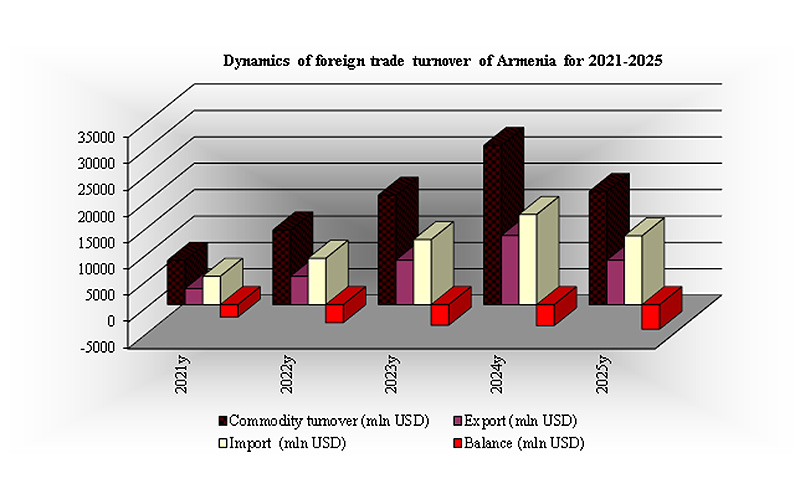
In total, Armenia's foreign trade turnover for January-July 2025 amounted to $11.4 billion, having decreased by 42% year-on-year (against 95% growth a year ago). In particular, the deterioration in the dynamics was noted for both exports and imports - to a 49.6-35.8% decline (from a 2.2-fold and 79.1% growth a year ago), the volumes of which dropped to $4.4 billion and $6.99 billion, respectively. Armenia's negative foreign trade balance for January-July 2025 increased by 24% year-on-year - to $2.6 billion, of which the negative $743.1 million and $701 million are the balance with the EAEU and EU countries, with a significant decline in the former and an insignificant increase in the latter. A considerable negative balance is also recorded this time in foreign trade with China - $712.4 million (with an annual growth of 8 times), and among the EAEU countries, the Russian Federation has a significant negative balance - $798.3 million (with an annual decline of 6 times). A reduction by several times is also recorded in the positive balance of foreign trade with the UAE - to $1.2 billion.
It should be noted that the Central Bank of Armenia and the IMF predict a decline in both exports and imports for 2025, but the rates they predict are very different. Thus, according to the Central Bank's expectations (June forecast), after almost equal growth of exports and imports in 2024 by 35.6-31.4%, in 2025 exports will decrease by 32.3-36.4% and imports by 29-34.2%, with growth in 2026 of both exports by 5.4-5% and imports by 4.7-3.1%. In its April forecast for 2025, the IMF predicted a much more modest decline in Armenia's foreign trade: exports by 10.4% and imports by 5.4%. The WB has not yet updated its forecast for Armenia's foreign trade in 2025, but in early November it already predicted a strong slowdown in growth of both exports to 5.6% and imports to 7%.