

ArmInfo. Members of the ruling Civil Contract faction in parliament propose to regulate legal relations related to the installation of charging stations for electric vehicles (in particular, not to consider this type of activity subject to licensing). The legislator also introduces new rules for autonomous electricity producers. The draft laws received a positive conclusion from the parliamentary commission on economic issues on September 2.
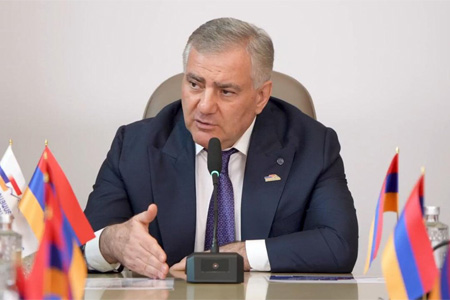
The rapporteur and co-author of the project, the head of the NA Standing Committee on Financial and Budgetary Affairs Tsovinar Vardanyan noted that in recent years the number of electric vehicles in Armenia has increased significantly, which is why it is necessary to ensure legal transparency of relations related to their charging, as well as to simplify this process.
"Charging of electric vehicles is not an activity subject to regulation and licensing in the energy sector. Individuals have the right to provide this service in accordance with other relevant legislative acts. The current Law does not have a clear provision on this issue," she noted
In this regard, in practice, especially for residents of apartment buildings, difficulties arise with charging electric vehicles. In particular, in order for citizens to be able to charge their car in their parking lot, they must contact the electricity distribution service provider - ESA to connect the consumption system of this parking lot to the power grid, and then conclude an electricity supply agreement, becoming a separate subscriber for this point of consumption. "This is an expensive and labor-intensive process, the need for which is often simply absent, since the capacity of the consumption systems of citizens' apartments already connected to the network is usually sufficient both to supply the apartment with electricity and to charge the electric vehicle," explained Tsovinar Vardanyan.
The proposed regulation will create for the consumer (subject to compliance with safety measures and exclusively for personal use) a clear opportunity to consume the electricity supplied to him also in his parking lot located outside the coverage area of the consumer's consumption system and in the adjacent territory, the deputy added. To do this, he will not need to conclude an electricity supply agreement with the ESA, becoming a separate subscriber for this point of consumption.
A similar opportunity is also provided to an economic entity (if the existing possibilities of its connection to the network allow it) to install a charging station, for example, in the courtyard of its store, and provide the corresponding services without licensing this type of activity.
The next proposed change, Vardanyan explained, will create an opportunity for autonomous electricity producers to participate in the competitive electricity market on equal terms with other entities with the same status, stimulating competition in the electricity market and expanding the circle of trade participants in its competitive sector.
Thus, the current Law On Energy establishes the right of an autonomous electricity producer to become a participant in the electricity market by refusing this status. In this case, by virtue of the law, it receives the status of a micro-producer of electricity. At the same time, the installed capacity of the power plant of a micro-producer of electricity is limited to 150 kW, and electricity production at a plant with an installed capacity exceeding this capacity is subject to licensing.
However, due to previously existing regulations, there are currently autonomous electricity producers with a capacity of up to 500 kW, which, due to the above-mentioned limitation on the capacity of the micro-producer of electricity station, are effectively deprived of the opportunity to participate in the wholesale market in the specified way. A situation arises when one of the producers with the same status, but operating installations of different capacities, can automatically, having renounced its status, become a participant in the wholesale market, while the other, in order to participate in this market, must obtain a license for the production of electricity in accordance with current legislation, subsequently bearing all the obligations provided for persons holding a license. In connection with, it is proposed to edit the relevant articles of the law, establishing the following: a micro- producer of electricity is a person producing electricity at a power plant with an installed capacity of up to 150 kW, and before May 1, 2022 - at an autonomous power plant with an installed capacity from 150 kW to 500 kW.