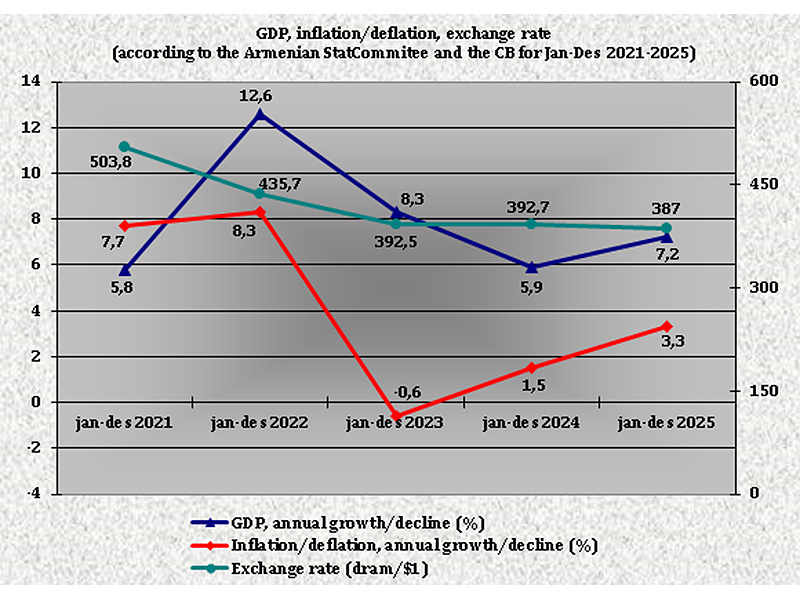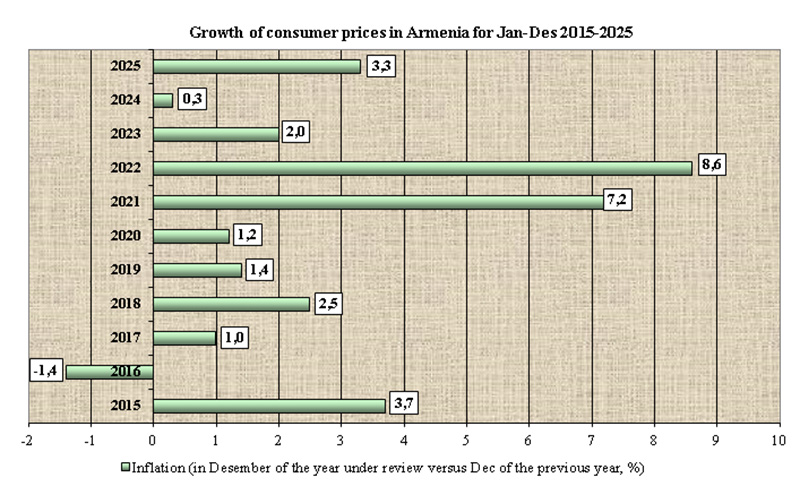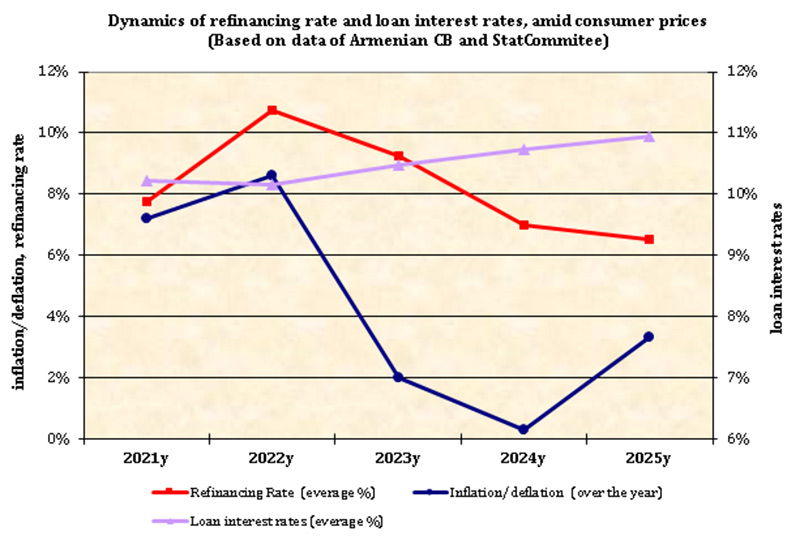


ArmInfo. Inflation of 1.5% was recorded in the consumer market of Armenia in January-December 2024 compared to the deflationary 0.6% in 2023. This increase was driven by a 2.2% rise in food prices and a 2.5% increase in service tariffs, while non-food prices decreased by 1.8%. In contrast, the previous year saw a more significant increase in prices across all three categories, with 3.5%, 3% and 0.1%, respectively. This is evidenced by data of the RA Statistical Committee, according to which the average monthly price growth on the consumer market was 0.1% in January- December 2024, in contrast to a 0.1% decline in 2023. In annual terms (compared to January-December 2023), inflation decreased to 0.3% (from 2% a year earlier). This decrease was facilitated by a 1.2% decrease in the price of food products and a 0.8% decrease in non-food products, with a slight slowdown in the growth of tariffs for services to 3%.
A year earlier, in January-December 2023, compared to January-December 2022, both food and non-food products became more expensive. However, there was a sharp slowdown in price growth, with food products increasing by 0.4% and non-food products by 1.7% (down from 12.5% and 7%, respectively). Tariffs for services also showed a slowdown in growth (from 5.2% to 4.5%). Vegetables increased in price by 9.7% in January-December 2024 (following a reversal in prices in 2023 from 2.1% growth to a 6.6% decline). Meanwhile, fruits fell in price by 0.1% compared to a slowdown in price growth in 2023 from 10.9% to 0.7%. In December alone, both vegetables and fruits increased in price by 12.2% and 2.4%, respectively (similar to growth of 10.6% and 5.6% in December 2023). The average weighted inflation in the vegetable and fruit group was 8.42% in December. This group of products, accounting for 9.04% of the consumer basket, had an upward effect on inflation by 0.74 percentage points (with December inflation at 1%, against 0.9% a year ago).
Among food products, the following increased in price in 2024: coffee - by 16.2%, sunflower oil - by 10.6%, butter - by 9.1%, trout - by 7.1%, chocolate - by 6.6%, flour - by 5.2%, lamb - by 4.7%, tea - by 4.3%, lentils - by 2.8% and beans - by 2.8%. In 2024, margarine fell in price by 9.2%, pasta by 5.1%, condensed milk by 4.5%, cheese by 4.4%, sugar and granulated sugar by 4.2%, pork by 4%, poultry by 3.7%, eggs by 3.7%, flour by 2.1%, beef by 1.6%, rice by 1.3%, milk by 0.8% and cottage cheese by 0.2%. The growth in cigarette prices slowed significantly from 11.5% in 2023 to 1.1% in 2024. Among alcoholic beverages, vodka and beer increased in price more significantly in 2024 - by 9.5% and 3.3%, respectively compared to growth of 8.3% and 2.6% in 2023), while wine prices decreased from a 1.7% increase in 2023 to a 1.5% decline in 2024. In the non-food market, jewelry increased in price by 14.8% in 2024, gardening equipment - by 5.7%, large and small household appliances - by 2.4-5%, and medicines - by 3.5%. Non- food products such as disposable household goods decreased in price by 5%, clothing and footwear by 3.4% and 1.2%, medical equipment by 3.1%, building materials by 2.4%, furniture by 1.5%, and tableware and kitchen utensils by 1.4% in 2024.
Gasoline and diesel fuel prices decreased by 6% and 9.4% in 2024, compared to a 24.3% and 0.2% increase in 2023. From January to December 2024, prices for gasoline and diesel fuel rose by 14.8% and 1.7% compared to the same period in 2023, which had seen a decrease of 11.9% and 12.8%. In the service sector, the most significant price increases from December 2023- December 2024 were for services related to personal transport, which rose by 3.1 times, transport insurance - by 18.9%, comprehensive recreation services - by 15.6%, transport services - by 5.8%, preschool and primary education - by 12.3%, higher education - by 7%, hairdressing and SPA salon services - by 4.6%, medical services - by 3.6%, and repair of household appliances - by 2.3%. Apartment renovation services increased by 3.8% over the year, while dry cleaning, clothing repair services, and clothing rental salons increased in price by 5.6% over 2024. Financial services saw a 1% increase over the reporting year. In 2024, only postal services saw a decrease in price by 5%, and hotel services decreased by 3.8%.
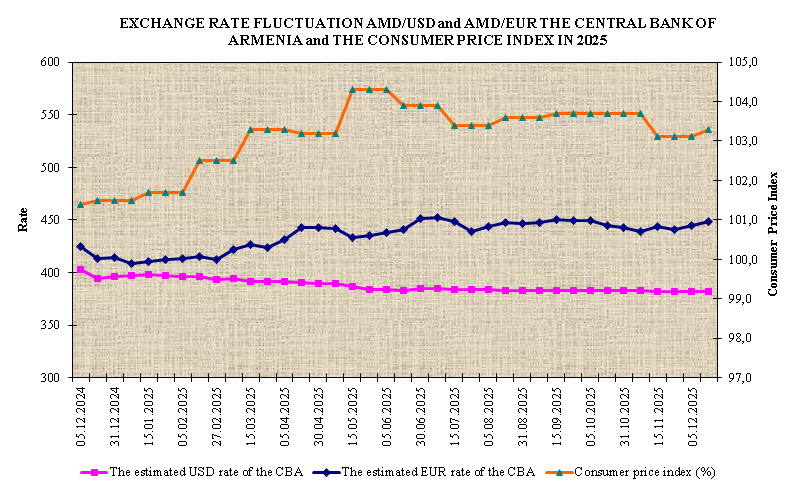
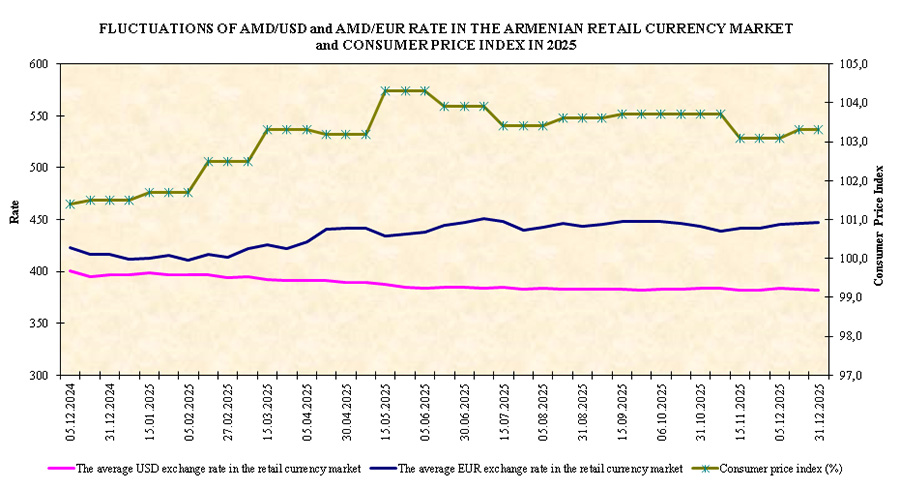
In December consumer market inflation was 1%, accompanied by a 1.9% devaluation of the dram against the dollar compared to 0.9% inflation and a 0.5% devaluation in December 2023. Throughout January to December 2024, consumer market inflation was 1.5%, paired with a 2% revaluation of the dram against the dollar by compared to a 0.6% deflation and a 2.5% devaluation in January-December 2023. By December 2024, the dram had strengthened against the dollar to AMD 396.5/$1 from AMD 404.5/$1 in December 2023.
It is noteworthy that the inflation rate forecasted by the Central Bank of Armenia for 2024 differed only slightly from the actual recorded figure - 1.6% (according to Case B) against the actual 1.5%. Let us recall that in its December forecast report, the Central Bank of Armenia predicted inflation of 2.1% (according to Case A) and 1.6% (according to Case B) for 2024, against a deflationary 0.6% in 2023. However, in 2025, according Central Bank of Armenia's forecast, there will be growth to 3.9% (according to Case A) or to 3.2% (according to Case B). Moreover, according to the Central Bank's expectations, inflation in the segment of non-exportable goods with rigid prices will decrease in 2024 to 2.6% (from 4.8% in 2023), after which it will increase to 4-2.8% in 2025. The International Monetary Fund predicted a lower inflation rate of 1% for Armenia in 2024, while expecting growth to reach 3.9% in 2025. It should be noted that on December 11, 2024, the Central Bank of Armenia announced that starting from 2025, the inflation target is set at 3% with a range of permissible deviations of +/- 1 percentage point, against the previous 4% (+/- 1.5). The RA Law "On the State Budget of Armenia for 2025" stipulates that the Central Bank will henceforth be guided by this inflation target (3%, +/- 1) when making decisions on monetary policy.