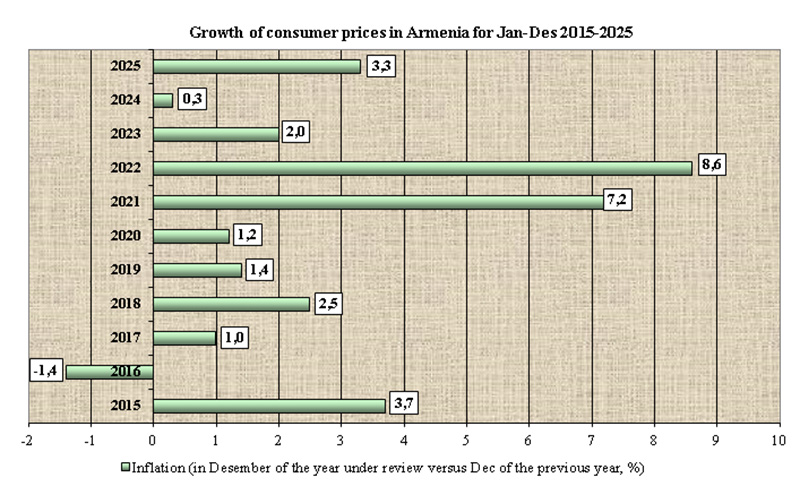



ArmInfo. In the consumer market of Armenia, annual inflation in November 2024 amounted to 1.4%, against a deflationary 0.5% in the same period of 2023. This was provoked by an increase in tariffs for services by 3%, in parallel with which there was an increase in the price of food products by 1.9% and a decrease in the price of non-food products by 2.1%.
As a comparison, we note that a year ago, deflation was formed as a result of a decrease in the price of food products by 3.1%, with an increase in tariffs for services by 2.9% and a slight increase in the price of non- food products by 0.2%. This is evidenced by the data of the RA Statistical Committee. In January- November 2024, inflation was recorded at 0.4% (against a deflationary 1.5% a year earlier), provoked by a 2.5% increase in tariffs for services and a 0.1% rise in food prices with a 2.1% decrease in non-food prices. For comparison, we note that in January-November 2023, food prices showed a decrease of 5.2%, in parallel with which there was a 0.2% increase in non-food prices and a 2.5% increase in tariffs for services.
On an annual basis (January-November 2024 to January-November 2023), inflation was recorded at 0.2% (against inflation of 2.2% a year ago), accompanied by a decrease in the price of both food products by 1.6% and non-food products by 0.7%, with an increase in tariffs for services by 3%. For comparison, we note that a year earlier, in January-November 2023 to January-November 2022, the main impact on inflation was due to an increase in tariffs for services by 4.6%, rather than an increase in the price of food and non-food products - by 0.8% and 1.8%, respectively.
Only in November 2024, inflation accelerated to 1.3% from October's 0.3% (against last year's November slight increase in inflation from 0.3% to 0.5%), provoked mainly by the acceleration of food prices from October's 0.8% to November's 2.8%, in parallel with which there was a slowdown in the growth of prices for non-food products from 0.4% to 0.2%, and a slower decrease in tariffs for services by 0.1% (compared to the October 0.4% decline). A year earlier, in November 2023, inflation in the consumer market came from an increase in prices for food and non-food products by 0.8% and 0.3%, with an increase in tariffs for services by 0.2%. It is worth noting that the increase in prices on the eve of the Christmas and New Year holidays is short-term, seasonal, caused by the emergence of increased demand for a significant group of consumer goods, which causes a general increase in consumer prices. However, as a rule, already in January of the new year, this trend is replaced by a general decrease in prices.
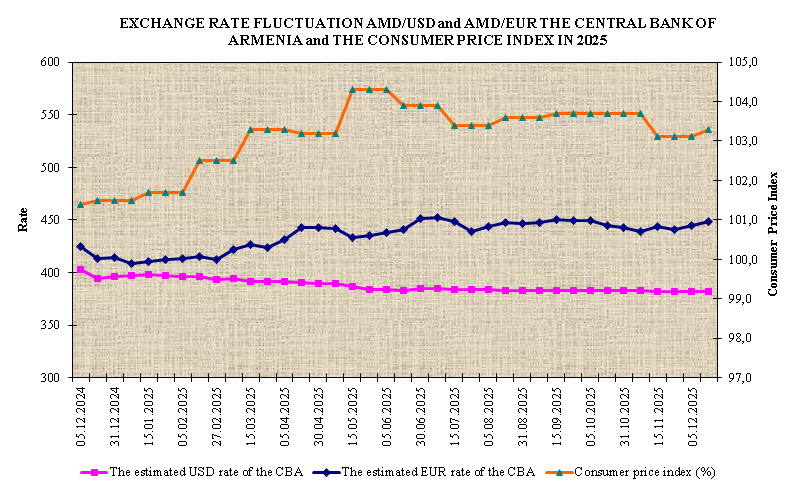
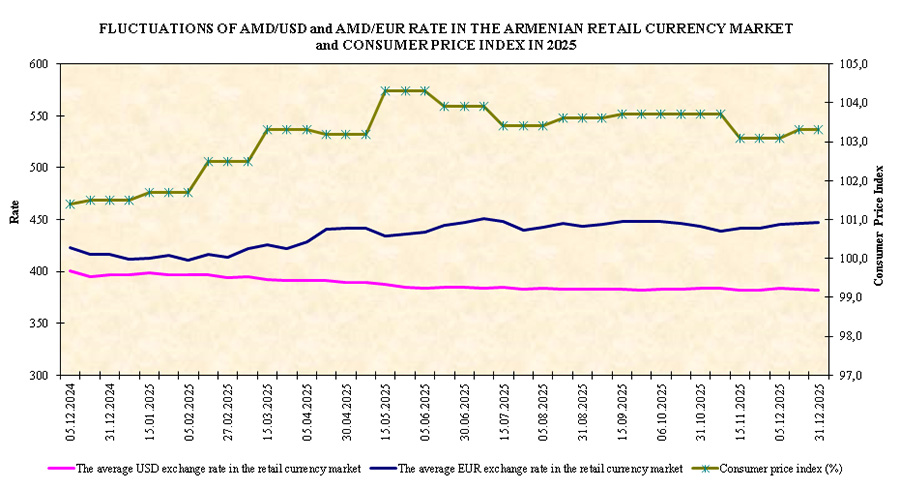
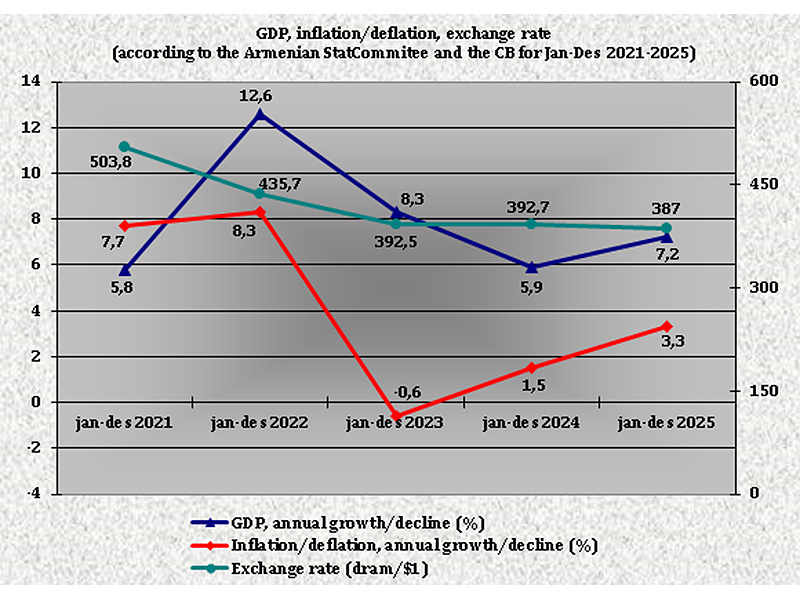
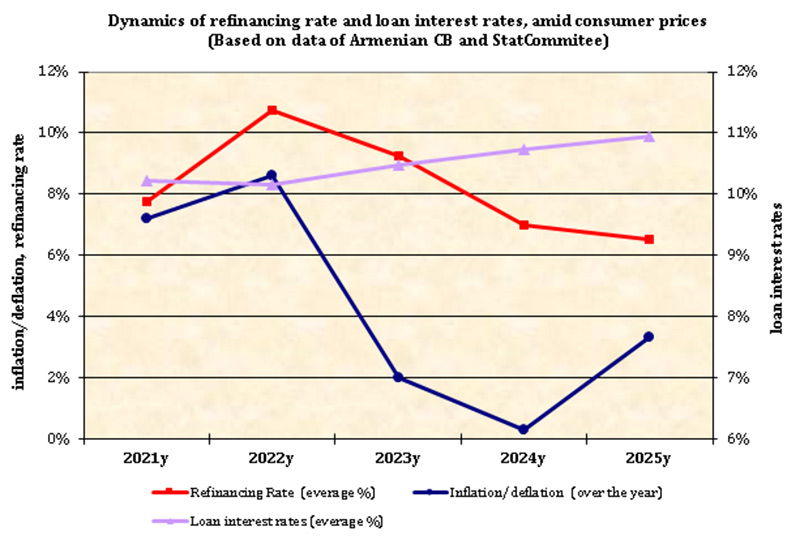
November consumer market inflation of 1.3% was accompanied by a 0.5% devaluation of the dram against the dollar (versus 0.5% inflation and a 0.4% revaluation of the dram against the dollar in November 2023). In January-November 2024, consumer market inflation of 0.4% was accompanied by a 3.8% revaluation of the dram against the dollar (versus 1.5% deflation and a 2% devaluation of the dram against the dollar a year earlier). In November 2024, compared to November 2023, the dram strengthened against the dollar by 3.4% - to 389 drams per $1 with inflation of 1.4% (versus 402.5 drams per $1 a year earlier, with a 1.8% devaluation, and 0.5% deflation).