


ArmInfo.The overall growth rates of Armenia's international trade turnover for 2023 are marked by unprecedented achievements, however, the structure of exports and imports, unfortunately, indicates the presence of significant imbalances and shifts containing significant long-term macroeconomic risks, Doctor of Economy Aghasi Tavadyan told ArmInfo.
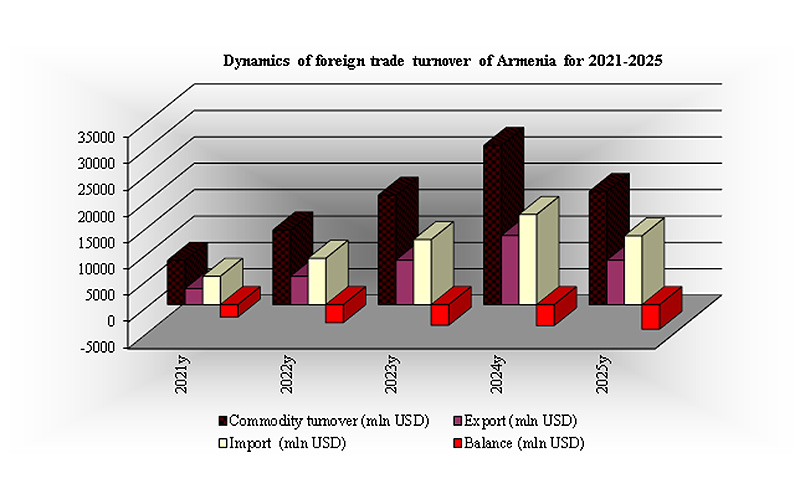
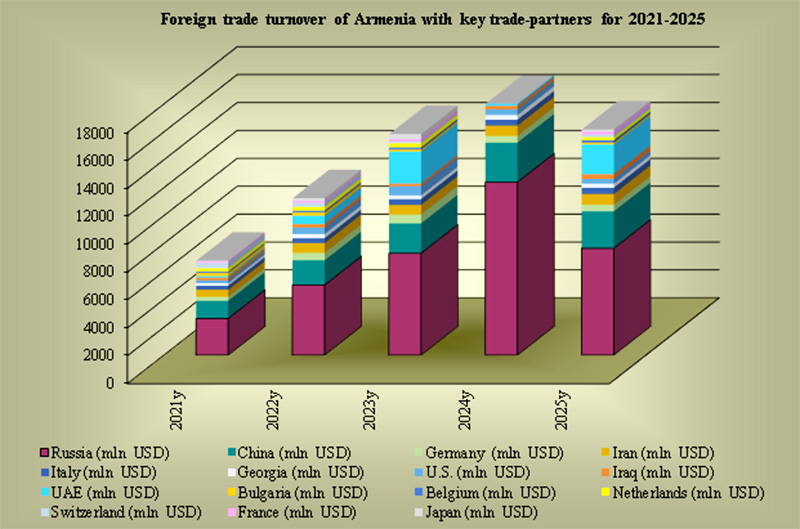
The specialist recalled that over the past two years, significant changes have occurred in the structure of Armenia's trade turnover. In 2023, exports increased by a significant 55.3 percent, from $5.4 billion (2022) to $8.4 billion. At the same time, imports increased by 40.2 percent, from $8.8 billion to $12.3 billion over the same period. Over the past two years, exports and imports have increased by 2.8 and 2.3 times, respectively. However, this is only the visible side of the "big numbers". The problem is that if we "remove from statistics", that is, purely mechanically exclude Russia, the United Arab Emirates and Hong Kong from trade turnover, then the indicators will begin to indicate a reduction in the growth rate of imports and a reduction in Armenian exports by as much as 12.2%.
Official statistics show that in 2023, 34.4 percent of Armenia's exports went to the United Arab Emirates (UAE) and Hong Kong. The specialist notes that in 2021, before international anti-Russian sanctions, only 2.8 percent of exports went to the UAE and Hong Kong ($84 million).
"In fact, we have a 35-fold increase in exports to the UAE and Hong Kong over the past 2 years, and this, in principle, could have happened solely due to the rapid growth of re-exports, and has nothing to do with goods of Armenian origin, because the same statistics indicate more than a modest increase in domestic industrial production in 2023 at 4.1% and an absolute decrease in the mainly export-oriented agricultural sector by 0.3%. Moreover, statistical data indicate that the UAE and Hong Kong played a minimal role in the dynamics of Armenia's imports, which mainly came from Russia," the expert said. To support his words, the economist cited data that, for example, until 2021, the traditional main export product in the Russian Federation was Armenian cognac, and in 2022-23 it was seriously surpassed by such goods as telephones, cars, medical devices and radio equipment. Over the same period, exports of machinery and equipment to Russia increased more than 10 times, and categories such as chemicals, plastics, ceramics, glass and metals grew more than 3 times. According to the economist, it was the increase in re-export of machinery and equipment that significantly contributed to the increase in exports. <Armenia has actually turned into an export-import hub, indirectly connecting Russian business with international markets through the United Arab Emirates and China.
According to the economist, all of the above does not indicate a stable growth of exports and imports, but speaks of a dangerous lateral shift associated exclusively with the changing conditions of international markets and new supply chains in today's geopolitical turbulence, which, in principle, do not impart stability to the Armenian economy, turning she is held hostage by external factors.
And yet, Tavadyan views the growth of exports to the EAEU countries as a positive factor, despite the overall unsatisfactory level of its diversification, which creates serious risks. Thus, exports to the EAEU countries in 2023 increased by 42.9 percent (from $2.5 billion to $3.6 billion). Russia will continue to remain the main trading partner of Armenia and the share of exports to Russia is the most diversified by product groups.
Exports to the Middle East in 2023 increased 2.6 times (from $1.0 billion to $2.5 billion), mainly due to re- exports from Russia to the UAE. Exports to Greater China increased 2.8 times, also due to re-exports from Russia to Hong Kong. Statistics show that at the end of last year, the European Union took only fourth place in exports, only 8.4 percent of export products were sent to EU countries. As the analyst noted, despite the fact that Armenia's international trade turnover has more than doubled over the past two years, a deeper analysis reveals the main structural problems that call into question the sustainability of this growth. The 2.8-fold increase in exports highlights the disproportionate dependence on two trading partners, particularly the United Arab Emirates and Hong Kong, which have seen a staggering 35-fold growth over the past two years.
This surge, driven largely by re-exports rather than domestically produced goods, highlights vulnerability to external market conditions and geopolitical changes. Armenia's transformation into an import-export hub highlights the precarious nature of current trade dynamics. Despite positive aspects, such as increased exports to the EAEU countries, the general lack of diversification of trading partners creates serious long- term risks. Fundamentally, while the headline numbers appear impressive, they do not reflect the deep structural problems that require a closer look at Armenia's economic stability and sustainable economic growth.